
The night sky can feel vast and random, a beautiful but unordered collection of stars. But for astronomers, it's a perfectly mapped grid. This map is called the celestial sphere, and understanding it is the key to moving beyond casual stargazing to targeted observation. It allows you to find any object in the sky if you know its coordinates, just like finding a city on Earth with latitude and longitude.
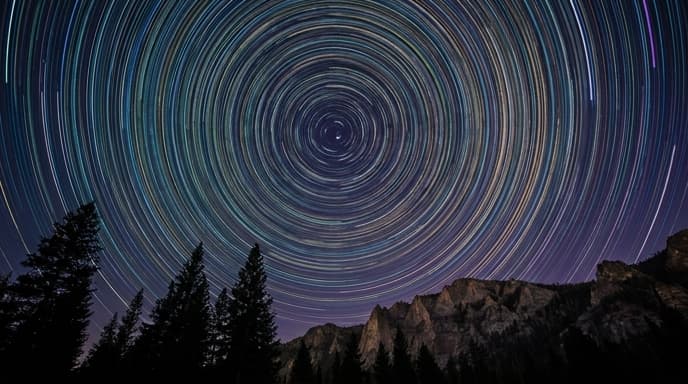
Think of the celestial sphere as a gigantic, hollow globe with Earth at its center. All the stars, planets, and galaxies are projected onto the inner surface of this sphere. While this isn't how the universe is physically structured, it's a powerful model for mapping the sky from our perspective on Earth.
The Sky's Framework: Poles and Equator
To create a grid, you need a starting point and reference lines. The celestial sphere borrows directly from Earth's geography.
Imagine extending Earth's axis of rotation out into space. The points where this axis pierces the celestial sphere are the celestial poles. In the Northern Hemisphere, this point is very close to the star Polaris, which is why it's called the North Star. The celestial equator is a great circle on the celestial sphere, in the same plane as Earth's equator. It divides the sky into northern and southern hemispheres.
Declination: The Sky's Latitude
If you understand latitude on Earth, you already understand declination. Declination (Dec) is the celestial equivalent of latitude, measuring how far north or south an object is from the celestial equator. It's measured in degrees, arcminutes, and arcseconds.
- The celestial equator is at 0° declination.
- Objects in the northern celestial hemisphere have a positive declination (e.g., +45°).
- Objects in the southern celestial hemisphere have a negative declination (e.g., -30°).
- The North Celestial Pole is at +90° declination, and the South Celestial Pole is at -90°.