
From a thin crescent to a brilliant full disk, the Moon cycles through its shapes each month. It's a familiar sight, but the reason behind it is often misunderstood. Many people believe the phases are caused by the shadow of the Earth falling on the Moon, but that's incorrect. That phenomenon is a lunar eclipse, which is a much rarer event.
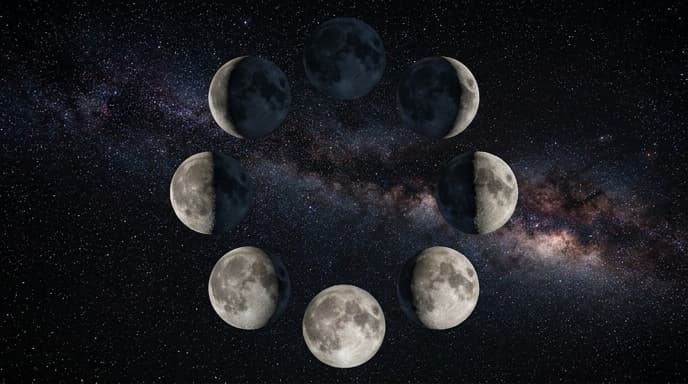
The real reason for the Moon's phases is simpler and more elegant: it's our changing view of the Moon's day and night side as it orbits our planet.
The Core Concept: One Half Is Always Lit
The first thing to understand is that the Moon doesn't produce its own light. Like Earth, it's illuminated by the Sun. At any given moment, exactly one half of the Moon is lit by the Sun (its 'day' side) and one half is in darkness (its 'night' side).
The 'phase' of the Moon is simply how much of that sunlit half we can see from our vantage point on Earth. As the Moon travels on its roughly 29.5-day orbit around our planet, the geometry of the Sun, Earth, and Moon changes. This means we see different amounts of its illuminated side.
The Eight Phases of the Lunar Cycle
The cycle is a continuous, smooth transition, but we typically break it down into eight distinct phases. The cycle is divided into two parts: waxing, when the visible illuminated portion is growing, and waning, when it is shrinking.
- New Moon: The Moon is between the Earth and the Sun. The sunlit side is facing away from us, so we can't see the Moon at all.
- Waxing Crescent: As the Moon moves in its orbit, we start to see a sliver of its sunlit side. This sliver grows day by day.
- First Quarter: The Moon has completed a quarter of its orbit. From Earth, we see exactly half of the sunlit side, so it looks like a half-moon.
- Waxing Gibbous: More than half of the Moon is illuminated, and the lit portion continues to grow.
- Full Moon: The Earth is between the Sun and the Moon. We see the entire sunlit face of the Moon.
- Waning Gibbous: After the Full Moon, the visible sunlit portion begins to shrink.
- Third Quarter (or Last Quarter): The Moon has completed three-quarters of its orbit. We again see a half-moon, but it's the opposite half from the First Quarter.
- Waning Crescent: The visible sliver continues to shrink until the Moon disappears again into the New Moon phase, starting the cycle over.
Earthshine: The Ghostly Glow
During the crescent phases, you might notice a faint glow on the 'dark' part of the Moon. This is called earthshine. It's sunlight that has reflected off the Earth and then onto the Moon's dark surface, faintly illuminating it. It's a beautiful reminder of the constant interplay of light between the Sun, Earth, and Moon.
FAQ
What is the difference between a lunar phase and a lunar eclipse?
Lunar phases are the normal, monthly cycle of how much of the sunlit Moon we see. A lunar eclipse happens only when the Full Moon passes directly through the Earth's shadow, which is a much less frequent alignment.
How long does the full lunar cycle take?
The complete cycle, from one New Moon to the next, takes about 29.5 days. This is known as a synodic month.
Does the Moon rotate?
Yes, the Moon rotates on its axis, but it does so at the same rate that it orbits the Earth. This is called synchronous rotation or tidal locking, and it's why we always see the same face of the Moon.
Why is it called a 'First Quarter' when it looks like a half-moon?
It's called the First Quarter because the Moon has completed the first quarter of its 29.5-day orbital cycle around the Earth at that point.
Key Takeaways
- The phases of the Moon are caused by our changing perspective of its sunlit half as it orbits Earth.
- The Earth's shadow is not involved in the regular phases; it only causes a lunar eclipse.
- 'Waxing' means the visible illuminated part is growing, while 'waning' means it's shrinking.
- The full cycle from New Moon to New Moon takes approximately 29.5 days.
- We always see the same side of the Moon due to synchronous rotation.
Related Reading
- A Beginner's Guide to Finding the North Star
- Choosing Your First Pair of Astronomy Binoculars
- How to Read a Star Chart or Planisphere