
For most of human history, a clear night meant a spectacular view of thousands of stars, the Milky Way, and planets. Today, for a majority of the world's population, that view has been erased by a phenomenon called light pollution. It's the single biggest obstacle for amateur astronomers.
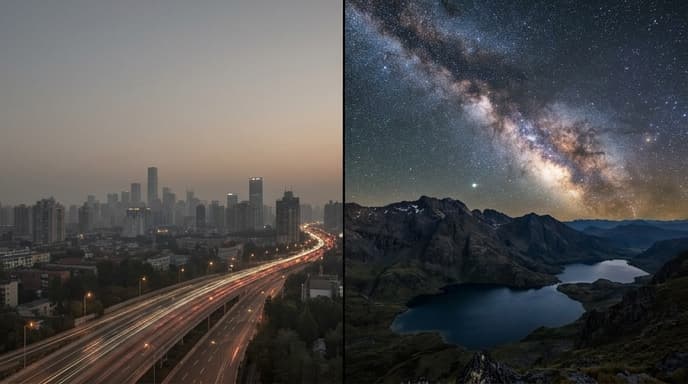
Understanding what light pollution is, how it's measured, and how to escape it can dramatically improve your stargazing experience, whether you're using your eyes, binoculars, or a telescope.
What Exactly Is Light Pollution?
Light pollution is the presence of excessive or misdirected artificial light in the night environment. Instead of shining only where it's needed—on streets and sidewalks—inefficient lighting blasts light upwards into the atmosphere. This light scatters off air molecules and dust, creating a dome of orange-white haze over populated areas. This artificial 'sky-glow' washes out the faint light from stars and galaxies, making them invisible.
There are a few key types:
- Sky-glow: The bright dome of light seen over cities.
- Glare: Excessive brightness that causes visual discomfort.
- Light Trespass: Light falling where it is not intended or needed, like a streetlight shining into a bedroom window.
Measuring the Darkness: The Bortle Scale
To help astronomers classify the quality of a night sky, John E. Bortle created a nine-level scale. The Bortle Scale runs from Class 1, the darkest skies available on Earth, to Class 9, an inner-city sky. It's a useful tool for understanding what you can expect to see from a given location.
- Class 8-9 (Inner-city sky): You can see the Moon, planets, and only a handful of the brightest stars. The sky looks orange or white.
- Class 6-7 (Suburban sky): The Milky Way is invisible or only faintly visible near the horizon. You can see major constellations but lose many fainter stars.
- Class 4-5 (Rural sky): The Milky Way becomes visible but lacks detail. Light pollution domes are visible on the horizon from nearby towns. This is a decent sky for casual stargazing.
- Class 2-3 (Truly dark sky): The Milky Way is high overhead and appears structured and detailed. The sky is noticeably dark, and countless stars are visible.
- Class 1 (Excellent dark-sky site): The Milky Way is so bright it can cast faint shadows. The view is overwhelmingly brilliant, with the full glory of the cosmos on display. These sites are extremely rare and remote.
How to Find Darker Skies
Escaping light pollution is the best way to level up your astronomy skills. Even a short drive can make a huge difference.
1. Use a Light Pollution Map: The easiest way to start is with an online light pollution map. Websites and apps use satellite data to show you the Bortle class of different areas. Look for the darkest 'blue' or 'gray' zones within a reasonable driving distance.
2. Head Away from Cities: Light pollution decreases with distance. As a general rule, you want to put as much distance as possible between you and any major metropolitan area. Driving an hour out of a city can often take you from a Class 7 to a Class 4 sky.
3. Seek Higher Elevation: Getting to a higher altitude can sometimes put you above the thickest layers of haze and atmosphere, leading to clearer views.
4. Find a Dark-Sky Place: Organizations like the International Dark-Sky Association (IDA) certify parks, reserves, and communities that have taken steps to protect their night skies. These 'Dark-Sky Places' are fantastic, dedicated locations for astronomy.
FAQ
Can filters on my telescope fix light pollution?
Light pollution filters can help by blocking specific wavelengths of light common in streetlights. They can improve contrast on certain objects like nebulae, but they are not a magic bullet. They don't restore the lost stars and can't replace the experience of a truly dark sky.
Does the Moon cause light pollution?
In a way, yes. A bright Moon, especially a Full Moon, acts like a natural source of light pollution. Its light washes out fainter objects in the same way city lights do. For this reason, deep-sky astronomers often plan their sessions around the New Moon.
What can I do to reduce light pollution at home?
You can make a difference. Use shielded light fixtures that direct light downwards. Use motion sensors and timers so lights are only on when needed. Choose warm-colored bulbs instead of harsh blue-white LEDs where possible.
Key Takeaways
- Light pollution is artificial light scattering in the atmosphere, creating 'sky-glow' that hides stars.
- The Bortle Scale measures sky darkness from Class 1 (pristine) to Class 9 (inner city).
- Escaping light pollution is the single most effective way to see more in the night sky.
- Use online light pollution maps to find darker locations within driving distance.
- Visiting a designated Dark-Sky Place offers some of the best stargazing opportunities.
Related Reading
- Choosing Your First Astronomy Binoculars
- A Beginner's Guide to Finding the North Star
- Understanding the Phases of the Moon: A Simple Explanation