
Animation is more than just making things move; it's about making them move in a way that feels alive. Whether you're watching a classic cartoon, a modern CGI blockbuster, or a video game character, the feeling of life often comes from a set of foundational guidelines known as the 12 principles of animation.
Developed by pioneering Disney animators in the 1930s, these principles were created to produce more realistic and expressive character animation. Today, they remain the bedrock of the art form, helping animators create motion that is dynamic, believable, and full of personality.
Core Principles for Believable Weight and Motion
These principles are fundamental to making an object or character feel like it exists in a physical space and is subject to the laws of physics.
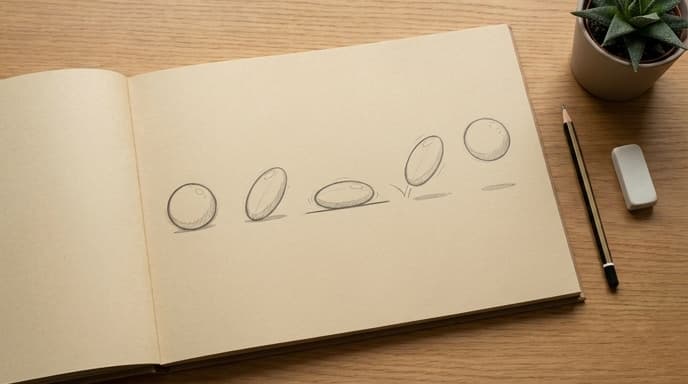
- Squash and Stretch: This is the most famous principle. It gives objects a sense of weight and flexibility. A bouncing ball squashes when it hits the ground and stretches as it falls and rebounds.
- Arcs: Living things rarely move in straight mechanical lines. Actions tend to follow a slightly circular path, or an arc, which creates more natural and fluid motion.
- Timing and Spacing: Timing refers to the number of frames for an action, dictating its speed. Spacing refers to how the frames are positioned. Close spacing creates slow movement, while wide spacing creates fast movement. This is key to showing weight and intention.
- Slow In and Slow Out: Most movements start slowly, accelerate, and then slow down before stopping. This principle, also called easing, mimics real-world momentum and makes motion less robotic.
Principles for Timing and Realism
This group of principles helps to ground the animation and make the actions feel more authentic and impactful.
- Anticipation: Before a major action, a character will often perform a smaller, opposite action to prepare the audience. Think of a character crouching down before jumping or winding up before a punch.
- Follow Through and Overlapping Action: When a character stops, not everything stops at once. Loose parts like hair, clothing, or limbs will continue to move for a moment. This is 'follow through.' 'Overlapping action' means different parts of the body move at different rates.
- Exaggeration: Animation is not reality. Exaggerating certain movements can make them more convincing and entertaining, without sacrificing believability.
Principles for Character and Appeal
These final principles are about performance, clarity, and making the character connect with the audience.
- Staging: This is about presenting an idea so that it is unmistakably clear. It involves camera placement, lighting, and character posing to direct the audience's attention to what is important.
- Straight Ahead Action and Pose to Pose: These are two different approaches to animating. 'Straight ahead' is drawing frame by frame, good for unpredictable action. 'Pose to pose' involves drawing key frames first and then filling in the gaps, which allows for more control.
- Secondary Action: These are smaller actions that support the main action, adding more dimension to the character. A character walking might also swing their arms or whistle.
- Solid Drawing: This principle emphasizes that an animator must understand the fundamentals of drawing in three-dimensional space, including form, weight, and anatomy.
- Appeal: Characters should be appealing to look at. This doesn't mean they have to be 'pretty'—even villains can have appeal. It means they have a charisma and design that makes them interesting to watch.
Frequently Asked Questions
Do these principles apply to 3D/CGI animation?
Yes, completely. While the tools are different (a computer model instead of a pencil), the underlying principles of what makes motion believable and appealing are exactly the same for 2D, 3D, and stop-motion animation.
Do you have to use all 12 principles all the time?
No. They are guidelines, not rigid rules. Different styles of animation may emphasize some principles over others. The key is to understand them so you can apply them intentionally to achieve a desired effect.
Who created the 12 principles?
They were introduced by Disney animators Ollie Johnston and Frank Thomas in their 1981 book The Illusion of Life: Disney Animation, based on the work of Disney animators throughout the 1930s.
Key Takeaways
- The 12 principles of animation are a set of guidelines for creating expressive and believable motion.
- They were developed by Disney animators to improve character animation.
- Principles like 'Squash and Stretch' and 'Arcs' help create physical realism.
- 'Anticipation' and 'Staging' are used to ensure actions are clear and impactful.
- 'Appeal' and 'Secondary Action' help to build character and personality.
- These principles are fundamental to all forms of animation, including 2D, 3D, and stop-motion.
Related Reading
- Foley Art: The Unseen Craft of Creating a Film's Soundscape
- How Match Cuts Create Genius Transitions in Film
- The Dutch Angle: Why Tilted Shots Make You Feel So Uneasy