
Some of the most powerful stories in gaming are never spoken. They’re discovered in a hastily abandoned diary, pieced together from the scorch marks on a wall, or understood by the placement of a single, forgotten toy. This is environmental storytelling, the art of making the world itself the narrator.
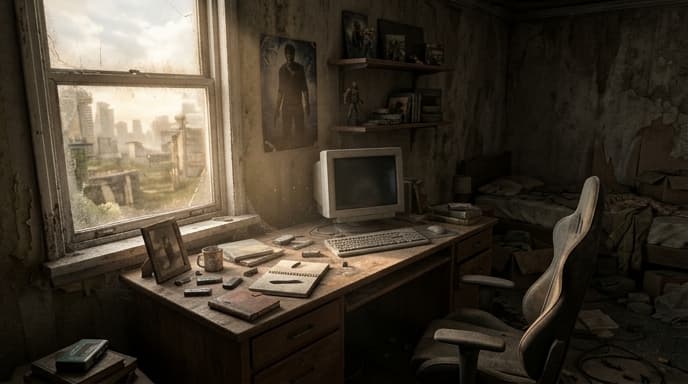
Understanding this technique will change how you play games. You'll move from being a passive audience for cutscenes to an active detective, decoding the history and secrets baked into the digital spaces you explore. It’s the ultimate expression of “show, don’t tell.”
What Is Environmental Storytelling?
At its core, environmental storytelling is the use of a game's level design, object placement, and visual aesthetic to tell a story. Instead of relying on dialogue, text logs, or cinematics, the narrative is embedded directly into the environment. A room isn't just a room; it's a crime scene, a historical record, or a character portrait.
This method respects your intelligence as a player. It trusts you to connect the dots. A skeleton slumped over a desk with a specific item tells a more poignant story than an NPC explaining that someone died at their desk. The first is a discovery; the second is an exposition dump.
How Designers Build a Silent Narrative
Creating a compelling silent narrative involves several layers of design. These elements work together to build a cohesive and believable story that unfolds as you explore.
Key techniques include:
- Object Placement: Every item is placed with intent. A spilled bottle of pills on a nightstand, a barricaded door from the inside, a child's drawing in a war-torn bunker—each object tells a micro-story.
- World Logic: The state of the world reflects its history. A city recently evacuated will have half-eaten meals on tables and cars left in the street. A long-abandoned ruin will be overgrown with nature, its structures weathered and collapsed.
- Implicit Guidance: Designers use light, color, and composition to draw your eye to key narrative elements. A single spotlight on a crucial clue or a path of discarded items can guide you through a story without a single waypoint.
Reading the Signs: What to Look For
Once you know the principles, you can start to see them everywhere. When you enter a new area, don't just look for enemies or objectives. Pause and ask yourself a few questions to decode the environmental storytelling at play.
Look for:
- Juxtaposition: What seems out of place here? A pristine object in a ruined building? A weapon in a child's nursery? These contrasts are almost always intentional story beats.
- Progression: How does the environment change as you move through it? A home that starts neat and tidy but becomes increasingly chaotic and fortified can tell a story of a character's paranoia and struggle.
- Absence: What isn't here? An empty picture frame on a wall or a table set for two with only one chair can speak volumes about loss and what came before.
Frequently Asked Questions
What's the difference between environmental storytelling and lore?
Lore is the background information of a world—its history, cultures, and rules. Environmental storytelling is a method for delivering that lore and other narrative details, like plot and character, through the game world itself.
Can a game have too much environmental storytelling?
Yes. When a scene is so cluttered with symbolic objects that it feels like a museum exhibit, it can break immersion. The best examples feel natural and lived-in, not staged for the player's benefit.
Do all games use this technique?
Most games use it to some degree for world-building, but some genres, like immersive sims, walking simulators, and survival horror, rely on it as their primary mode of narrative delivery.
Key Takeaways
- Environmental storytelling uses the game world itself to convey narrative, character, and plot.
- It is a form of “show, don’t tell” that respects the player's intelligence.
- Designers use techniques like intentional object placement and world logic to build silent stories.
- To spot it, look for juxtaposition, progression, and the telling absence of objects.
- This technique often creates a more memorable and personal story than direct exposition.
Related Reading
- Understanding Ludonarrative Dissonance
- How Procedural Generation Is Changing Game Design
- The Role of Level Design in Player Experience