
You enter a room. A dinner table is set for two, but one plate is untouched and covered in dust. A chair is knocked over. On the floor lies a single, faded photograph. No character has spoken, no text has appeared on screen, but a story has already begun to form in your mind. This is the power of environmental storytelling.
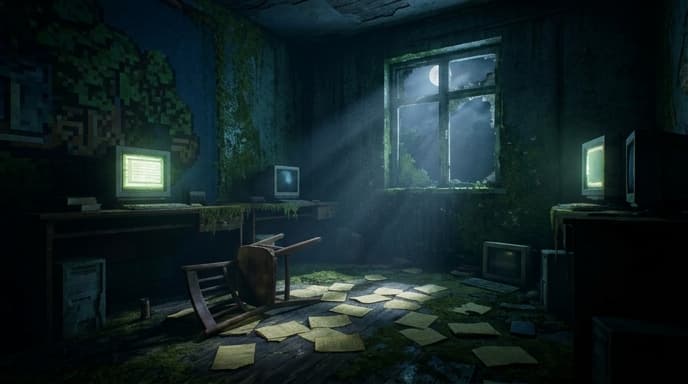
It's the art of using the game world itself—the architecture, the objects, the lighting, the decay—to tell a story. Instead of having the narrative explained to you through cutscenes or dialogue, you piece it together yourself by observing the digital space around you. It's a technique uniquely suited to interactive entertainment, rewarding curiosity and exploration.
Why 'Show, Don't Tell' Is So Powerful in Games
The principle of 'show, don't tell' is a cornerstone of all creative writing, but it has special importance in games. Because the player has agency and can move through the world at their own pace, they can become a detective. Discovering the story feels more personal and impactful than simply being told it.
Environmental storytelling respects the player's intelligence. It trusts you to connect the dots. A bloody handprint on a wall implies a struggle far more effectively than an NPC saying, 'There was a struggle here.' It turns the player from a passive audience member into an active participant in the narrative.
Key Techniques of Environmental Storytelling
Designers use a well-established toolkit to embed stories into the game world. Once you know what to look for, you'll start seeing these techniques everywhere.
- Object Placement (Tableaus): This is the art of arranging objects to imply an event. The dusty dinner table is a perfect example. A skeleton slumped over a desk with a pen in its hand tells a story of someone working until the very end. These static scenes are called 'tableaus.'
- Architecture and Design: The very structure of a building can tell you about its inhabitants. Is a society's architecture grand and opulent, or brutalist and functional? The underwater city of Rapture in BioShock, with its art deco style and leaky halls, tells a story of a failed utopia before any character speaks.
- Progression and Change: How an environment changes over time is a powerful narrative tool. As you progress through a game, you might see a city gradually fall into ruin, or watch a small camp grow into a fortified settlement. This shows the impact of events and the passage of time.
- Incidental Detail: Small, seemingly unimportant details add texture and history to a world. Graffiti on a wall, notes left on a computer terminal, or the types of books on a shelf can reveal the culture, conflicts, and daily life of the people who inhabited that space.
How to Get Better at Reading the Environment
Developing your eye for environmental storytelling can deepen your appreciation for the games you play. The next time you're exploring a game world, slow down and ask yourself a few questions:
- Why is this here? Every object in a well-designed game was placed intentionally. Ask why the artist put that specific item in that specific spot.
- What happened right before I arrived? Look for signs of recent events—a still-smoldering fire, a hastily abandoned meal, a barricaded door.
- Who lived here? Look for clues about the former inhabitants. What were their priorities? What were their fears? Their personal belongings are your primary evidence.
By engaging with the world on this level, you're not just playing the game; you're collaborating with the designers in the act of storytelling.
Frequently Asked Questions
What are some of the best examples of environmental storytelling?
Games like BioShock, Fallout 3, Gone Home, and What Remains of Edith Finch are widely celebrated for their masterful use of this technique. The Dark Souls series is also famous for telling most of its lore through item descriptions and the state of the world.
Does this mean games shouldn't have dialogue or cutscenes?
Not at all. Environmental storytelling is one tool among many. The most compelling game narratives often use a combination of techniques: environmental cues for world-building and history, and dialogue or cutscenes for character development and plot advancement.
Can environmental storytelling be misleading?
Yes, and that can be a deliberate choice. A designer might place clues that lead the player to a false conclusion, creating a narrative twist when the truth is later revealed. It's another way to play with player expectations.
Key Takeaways
- Environmental storytelling uses the game world and object placement to convey narrative.
- It follows the 'show, don't tell' principle, turning the player into an active participant in the story.
- Key techniques include creating tableaus with objects, using architecture to reflect culture, and showing change over time.
- This method is powerful because it rewards player curiosity and makes discovery feel personal.
- You can improve your appreciation of games by actively questioning the details of the environments you explore.
Related Reading
- The Three-Act Structure: A Timeless Formula for Storytelling
- When Gameplay and Story Clash: Understanding Ludonarrative Dissonance
- How Procedural Generation Creates Endless Worlds in Games