
Great level design is an invisible art. When it's working perfectly, you don't even notice it. You just feel smart, intuitive, and completely immersed in the world as you navigate complex spaces without ever getting lost. This seamless experience is often the product of a design principle called 'flow.'
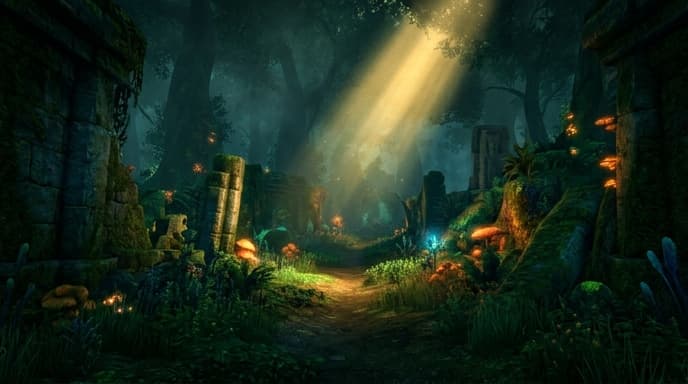
Flow is the practice of guiding the player through a level using subtle environmental cues instead of explicit instructions like arrows or map markers. It’s about making the correct path feel like the most natural choice, empowering the player and keeping them engaged with the game world, not its interface.
The Core Tools of Flow: Light, Color, and Composition
Level designers use a visual language inspired by art and architecture to direct your attention. By manipulating these core elements, they can make a critical path stand out without breaking your immersion.
- Light: Our eyes are naturally drawn to the brightest point in a scene. Designers use this instinct by placing key light sources—a sunbeam through a window, a single lit lamp in a dark cave—to illuminate the path forward or highlight an important object.
- Color: A splash of a contrasting color can serve as a powerful navigational tool. A red valve in a world of gray pipes or a yellow ledge in a sea of brown rocks immediately signals 'this is important' or 'you can interact with this.'
- Composition: The arrangement of objects in a scene can create leading lines that point your eyes toward a destination. A fallen pillar, a winding road, or the angle of a building can all form lines that subconsciously guide your gaze and movement.
Breadcrumbing and Landmarks: Leaving a Trail
For larger, more open levels, designers use other techniques to ensure you can orient yourself and find your way. These methods are all about creating a mental map of the space.
Breadcrumbing is the practice of placing a series of small, repeating objects or rewards along a path. Think of a line of coins in a platformer or a trail of health packs in a shooter. Following the trail feels natural and consistently rewards you for moving in the right direction.
Landmarks are large, unique, and easily recognizable structures in the game world, like a towering castle, a strange rock formation, or a massive tree. These serve as constant points of reference, allowing you to understand where you are in the world and navigate relative to their position. They are the anchors of any good open-world map.
Balancing Guidance with Player Freedom
The ultimate goal of flow is not to force the player down a single corridor. It's to provide gentle suggestions that make navigation feel intuitive, not restrictive. In open-world games, good flow design guides you toward the main quest path but still allows for—and even encourages—deviation and exploration.
The invisible hand should feel like a helpful nudge, not a railroad. When done right, it allows you to feel the satisfaction of discovery while minimizing the frustration of being truly lost.
Frequently Asked Questions
Is flow the same as the psychological state of 'flow'?
They are related but distinct. The psychological state of 'flow' is being fully immersed in a challenging activity. Good level design flow can help a player achieve this state by removing navigational friction and keeping them focused on the core gameplay.
Why don't designers just use a map marker?
They often do, but relying solely on UI elements can pull a player out of the game world. Integrating guidance into the environment itself maintains immersion. The best designs often use both: environmental flow for moment-to-moment gameplay and map markers for high-level orientation.
Does this apply to multiplayer level design?
Yes, absolutely. In competitive games, flow is used to design maps that are balanced, have clear sightlines, and feature intuitive routes between key objectives. Good flow ensures players can learn and navigate the map quickly.
Key Takeaways
- Flow in level design is the art of guiding players with subtle environmental cues.
- Core techniques include the strategic use of light, color, and composition to draw the player's eye.
- Breadcrumbing (leaving a trail of items) and landmarks (large, visible structures) help with navigation in larger spaces.
- The goal is to make the correct path feel like the most natural choice, not the only one.
- Good flow enhances immersion by reducing the need for intrusive UI elements like map markers.
Related Reading
- How Environmental Storytelling Creates Deeper Game Worlds
- Emergent Narrative: How Games Tell Stories Without a Script
- The Power of Positive Feedback Loops in Game Design