
Some of the most visually striking video games don't try to mimic reality. Instead, they embrace a stylized look that resembles a classic cartoon or a comic book page brought to life. This aesthetic is often achieved through a clever computer graphics technique called cel shading (or toon shading).
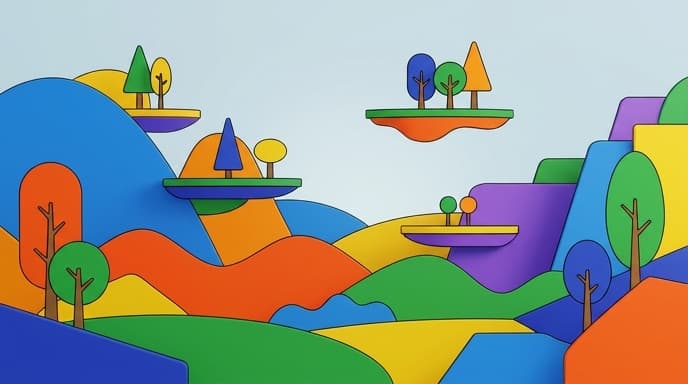
Cel shading is a type of non-photorealistic rendering designed to make 3D models appear flat. It swaps smooth gradients and complex lighting for bold colors, hard shadows, and distinct outlines, tricking our eyes into seeing a 2D drawing where a 3D object exists.
How Cel Shading Works
Traditional 3D rendering aims for realism by calculating how light bounces off surfaces, creating soft shadows and smooth transitions between colors. Cel shading intentionally rejects this. The process generally involves two main steps.
1. Flattening the Colors
Instead of a smooth gradient from light to dark, a cel-shaded object has a small number of distinct color bands. A surface facing the light gets a bright, solid color. A surface in shadow gets a darker, solid color. The transition between them is a hard, sharp line. This mimics the look of old-school animation 'cels' (celluloid sheets), which were painted with flat colors.
2. Creating the 'Ink' Outline
To complete the comic book effect, a black outline is drawn around the edges of the 3D model. There are several ways to do this, but a common method involves rendering the model twice. The first time, it's rendered slightly larger and in all black. The second time, the normal, colored model is rendered on top. The black version pokes out from behind, creating a perfect outline.
Why Developers Choose Cel Shading
Beyond just looking cool, there are practical reasons for using a cel-shaded art style. It offers several distinct advantages over photorealistic graphics.
- Timelessness: Photorealistic graphics can look dated within a few years as technology improves. A strong, stylized art style like cel shading, however, tends to age much more gracefully.
- Clarity: The bold colors and clear outlines make characters and important objects stand out from the background. This can be very helpful in fast-paced action games, improving readability.
- Performance: Because the lighting calculations are simpler than in realistic rendering, cel shading can sometimes be less demanding on hardware, allowing for smoother performance.
- Expressiveness: The style is a natural fit for games with exaggerated animations and fantastical themes, allowing artists to create vibrant and imaginative worlds.
FAQ
What was the first cel-shaded video game?
While experimental uses existed earlier, the Sega Dreamcast game Jet Set Radio, released in 2000, is widely credited with popularizing the cel-shaded look and bringing it into the mainstream.
Is cel shading an 'easy' art style?
No. While the rendering technique might be less complex in some ways than photorealism, creating a visually appealing and cohesive cel-shaded world requires a huge amount of artistic skill in character design, color theory, and animation.
Can any 3D model be cel-shaded?
Yes, a cel-shading shader can be applied to almost any 3D model. However, models that are specifically designed with cel shading in mind—often with simpler geometry and bold shapes—tend to look the best.
Key Takeaways
- Cel shading is a rendering technique that makes 3D graphics look like 2D hand-drawn animation.
- It uses flat colors and hard shadows instead of the smooth gradients found in realistic rendering.
- A characteristic black outline is often added to complete the comic book or cartoon aesthetic.
- Developers choose it for its timeless quality, visual clarity, and expressive potential.
- The style was popularized in the early 2000s and remains a popular choice for stylized games today.
Related Reading
- How the 12 Principles of Animation Bring Your Favorite Characters to Life
- How Generative Adversarial Networks (GANs) Create Realistic Images
- The Dutch Angle: Why Tilted Shots Make You Feel So Uneasy