
In the world of filmmaking, editing is often called the 'invisible art.' When it's done well, you don't notice the cuts; you simply feel the story. One of the most fundamental principles behind this art is a psychological phenomenon known as the Kuleshov effect.
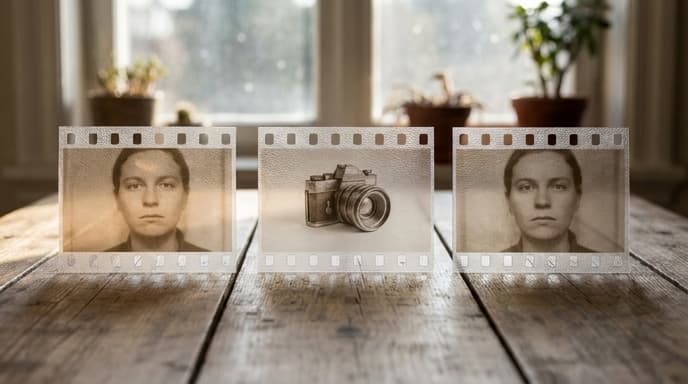
The Kuleshov effect demonstrates that viewers infer meaning and emotion based on the sequence of shots, often projecting their own feelings onto a neutral image. It’s the bedrock of cinematic language, proving that in film, 1 + 1 doesn't equal 2—it equals something new entirely.
The Original Experiment
In the early 1920s, Soviet filmmaker Lev Kuleshov conducted a simple but groundbreaking experiment. He took a single, expressionless shot of an actor and intercut it with three different images:
- A bowl of soup.
- A girl in a coffin.
- A woman on a divan.
Audiences who saw the sequence of the actor and the soup praised his performance, commenting on the subtle way he conveyed hunger. Those who saw the actor followed by the coffin spoke of his profound grief. And those who saw him before the woman noted his look of desire. The shot of the actor was the exact same every time. The audience created the emotion in their own minds by connecting the two images.
How the Kuleshov Effect Works
The Kuleshov effect works because our brains are wired to find patterns and create stories. When we see two images in sequence, we automatically assume they are related. We create a narrative bridge between them. The editor doesn't need to show the actor feeling hungry; they only need to show the actor and the idea of food, and our brain does the rest of the work.
This principle is the foundation of all continuity editing. It's what allows a 'shot-reverse-shot' sequence in a conversation to feel like two people are in the same room, looking at each other, even if the shots were filmed hours apart.
Modern Examples of the Kuleshov Effect
Once you understand the Kuleshov effect, you will see it everywhere, from blockbuster films to television commercials and even video game cutscenes. It is the basic grammar of visual storytelling.
Consider these common uses:
- Creating Emotional Context: A character looks off-screen. The next shot is of a child playing in a park. When we cut back to the character, we assume they are feeling nostalgic or paternal. Change the second shot to an approaching storm, and we assume they are feeling dread.
- Building Suspense: In a thriller, an editor might cut from a character's worried face to a slowly opening door. The door itself isn't scary, and the face is just worried. But together, they create intense suspense.
- Influencing Perception: In advertising, a product is shown immediately after images of happy, successful people. The goal is to make the viewer associate the positive feelings from the people with the product itself.
Why It's a Transferable Skill
Understanding the Kuleshov effect isn't just for filmmakers. It's a lesson in communication. It teaches you that context is everything. The meaning of a piece of information—whether an image, a statistic, or a sentence—can be completely transformed by the information that comes immediately before or after it. It’s a powerful reminder that how you sequence your ideas is just as important as the ideas themselves.
Frequently Asked Questions
Is the Kuleshov effect a form of manipulation?
All storytelling is a form of manipulation, in the sense that it is designed to elicit an emotional response. The Kuleshov effect is a tool, and like any tool, it can be used to create profound art or deceptive propaganda. Its ethical dimension depends on the creator's intent.
Does it only work with neutral expressions?
No. The effect is most dramatic with a neutral expression because it highlights how much emotion the viewer is projecting. However, the principle of juxtaposition works with any shots. An already sad face will seem even more tragic when followed by a heartbreaking image.
How does this relate to montage?
The Kuleshov effect is the psychological principle that makes montage so effective. A montage is a series of short shots edited into a sequence to condense space, time, and information. The rapid juxtaposition of images in a montage relies on the Kuleshov effect for the audience to build the thematic and emotional connections.
Key Takeaways
- The Kuleshov effect is when a viewer's interpretation of a shot is influenced by the shot that precedes or follows it.
- It proves that audiences actively participate in creating meaning by connecting sequential images.
- The original experiment used a single shot of a neutral face paired with different objects to evoke different emotions.
- This principle is a fundamental tool in editing for creating emotion, building suspense, and guiding audience perception.
- Understanding this effect teaches a broader lesson about how context shapes meaning in all forms of communication.
Related Reading
- The Three-Act Structure: A Timeless Formula for Storytelling
- Environmental Storytelling: How Environmental Storytelling Shapes Narrative
- Listen Closely: When Sound Design Becomes a Core Gameplay Mechanic