
Some games feature worlds so massive that no player could ever see all of it. From the blocky landscapes of Minecraft to the sprawling galaxies of No Man's Sky, these experiences are made possible by a powerful technique: procedural content generation (PCG).
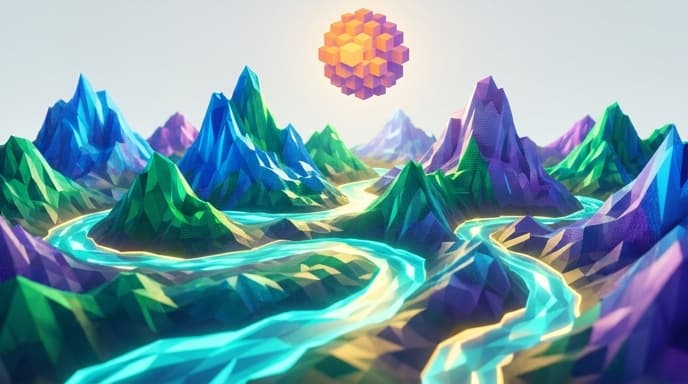
Instead of an artist or designer hand-crafting every mountain, tree, and creature, the game itself builds the world using a set of rules and algorithms. This approach allows small teams to create enormous amounts of content and ensures that every player's journey can be unique. Let's explore how it works.
What Is Procedural Generation?
At its core, procedural generation is about creating content on the fly using algorithms. The developer doesn't build the final product; they build a system that can create the product. Think of it as giving the computer a recipe rather than a finished cake. The computer can then bake a slightly different, but still recognizable, cake every time.
This 'recipe' is a set of rules and parameters. For example, a rule for generating a fantasy forest might be:
- Start with rolling terrain.
- Cover 70% of the ground with grass.
- Place clusters of oak and pine trees.
- Add a winding river that flows from high ground to low ground.
- Scatter a few rocks and bushes.
By introducing randomness within these rules, the system can generate countless unique forests.
The Magic of the 'Seed'
If the world is generated randomly, how can two players visit the same place? The answer is the seed. A seed is a number or string of text that acts as the starting point for the random number generator. As long as the algorithm and the seed are the same, the 'random' output will be identical every time.
This is how Minecraft players can share their world with others. By sharing the world seed, they ensure that anyone who uses it will generate the exact same layout of mountains, caves, and villages. The entire world is encoded in that one small piece of data.
Types of Procedurally Generated Content
Procedural generation isn't just for landscapes. Developers use it to create all sorts of game elements:
- Levels and Maps: Classic roguelike games like Rogue and modern titles like The Binding of Isaac generate new dungeon layouts for every playthrough.
- Items and Loot: Games like Diablo and Borderlands generate millions of weapon variations by combining different parts, stats, and special effects.
- Quests and Stories: Some complex games generate simple quests or character backstories algorithmically to populate their worlds.
- Textures and Music: PCG can even be used to create visual textures for objects or generate background music that adapts to the gameplay.
Pros and Cons of This Approach
Procedural generation is a powerful tool, but it comes with tradeoffs. On the plus side, it offers massive replayability, creates unique player experiences, and can save enormous amounts of development time. It allows for game worlds of a scale that would be impossible to create manually.
However, the content can sometimes feel generic or nonsensical because it lacks the intentionality of a human designer. A handcrafted level can have deliberate pacing, clever puzzles, and beautiful compositions that are hard for an algorithm to replicate. The best games often use a hybrid approach, combining handcrafted 'hero' assets or locations with procedurally generated content to fill in the gaps.
Frequently Asked Questions
Is procedural generation the same as AI?
Not exactly. While both involve algorithms, procedural generation is typically focused on creating static content based on a set of rules and randomness. AI in games usually refers to the dynamic, decision-making behavior of non-player characters (NPCs).
Are procedurally generated games smaller in file size?
Often, yes. Because the game stores the 'recipe' (the algorithm and seed) instead of the 'cake' (the entire world map), the initial file size can be surprisingly small. The content is generated by the player's computer as it's needed.
What was the first game to use procedural generation?
One of the earliest examples is the 1984 space trading game Elite, which used procedural generation to create a galaxy with thousands of star systems. The entire game, including its vast universe, fit onto a floppy disk.
Key Takeaways
- Procedural generation uses algorithms to create game content, such as levels, items, and worlds.
- It allows for massive scale and high replayability, as the content can be different each time.
- A 'seed' is a starting value that allows a specific procedurally generated world to be recreated and shared.
- The technique is used for more than just maps; it can generate loot, quests, and even music.
- While powerful, it can sometimes lack the intentional design of handcrafted content.
Related Reading
- Understanding the Core Game Loop: The Secret to Addictive Game Design
- Roblox Scripting Basics: Make Your First Part Change Color