
The sounds you hear in a movie are rarely the ones captured on set. The dialogue is often re-recorded, the background noise is carefully constructed, and every single footstep, door creak, and jacket rustle is custom-made in a studio. This is the world of Foley art, a unique form of sound design that brings a film's physical world to life.
Named after its pioneer, Jack Foley, this craft is part performance and part engineering. Foley artists watch a film projected on a screen and use a vast collection of props and their own bodies to perform the sounds in sync with the action. It's a subtle art that, when done well, you never even notice.
The Three Pillars of Foley: Feet, Moves, and Specifics
The work of a Foley artist is typically broken down into three main categories. These layers are recorded separately and then mixed together to create a seamless sonic texture.
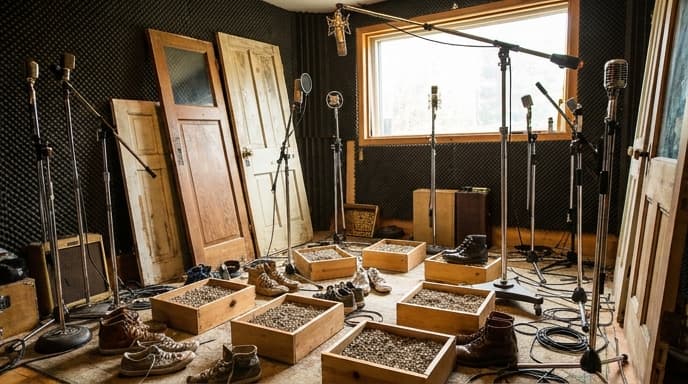
- Feet: This is the most fundamental layer. Foley artists recreate the sound of every footstep for every character. They use dozens of pairs of shoes and multiple surfaces—called Foley pits—filled with dirt, gravel, wood, and tile to perfectly match the character's gait, weight, and environment.
- Moves: This category covers the sounds of clothing and fabric. The rustle of a leather jacket as a character turns, the swish of a dress, or the rubbing of denim jeans are all performed, usually by the artist themselves wearing or handling different materials.
- Specifics: Also called props, this is everything else. It could be the clink of a glass, the thud of a punch, the crinkle of a letter, or the squeak of a chair. This is where Foley artists get famously creative, using unexpected objects to create the perfect sound.
The Foley Stage: A Playground of Sound
A Foley studio, or stage, looks less like a high-tech recording booth and more like a hoarder's garage. It's filled with an eclectic and bizarre collection of objects that have been gathered over years for their unique sonic properties. You might find old car doors, various types of metal, broken furniture, and countless small props.
This library of junk is the artist's instrument. A common trick is to use celery stalks for the sound of breaking bones or a heavy staple gun for a gunshot mechanism. The goal isn't to find the object you see on screen, but to find an object that sounds more like it than the real thing.
Why Not Just Use a Sound Library?
While sound effect libraries are vast, Foley provides a level of detail, sync, and performance that a pre-recorded sound cannot. A Foley artist doesn't just make a footstep sound; they perform the character's emotion through their steps. Are they sneaking? Rushing? Exhausted? That performance adds a layer of subconscious information for the audience.
Furthermore, every sound is perfectly synchronized with the picture and has the correct acoustic perspective for the scene. It's the difference between a generic, canned effect and a bespoke, handcrafted piece of the film's world.
Frequently Asked Questions
Is Foley the same as sound effects?
Foley is a specific type of sound effect. The term 'sound effects' can also include non-Foley sounds like explosions, engine noises, or digital interface sounds, which are often sourced from libraries or created by sound designers.
Do video games use Foley?
Yes, extensively. The interactive nature of games requires a massive library of sounds for every possible player action. Foley artists are crucial for creating realistic and varied sounds for character movements, weapon handling, and interactions with the game world.
Is dialogue considered Foley?
No. Dialogue is its own department. Sometimes, dialogue that was poorly recorded on set is re-recorded in a studio, a process called Automated Dialogue Replacement (ADR), but this is separate from Foley.
Key Takeaways
- Foley is the art of performing and recording custom sound effects in sync with a film.
- It is typically broken down into three categories: footsteps, clothing movement, and specific prop sounds.
- Foley artists use a wide variety of props to create sounds, often using non-obvious objects.
- The performance aspect of Foley adds an emotional layer and nuance that pre-recorded effects lack.
- This technique is essential for creating an immersive and believable audio world in film, TV, and video games.
Related Reading
- The 12 Principles of Animation Bring Your Favorite Characters to Life
- The Kuleshov Effect: How Film Editing Controls Your Emotions
- The Dutch Angle: Why Tilted Shots Make You Feel So Uneasy