
Long before wearables could measure your heart rate or blood oxygen, they mastered a fundamental task: tracking your movement. The technology that makes this possible is a pair of microscopic sensors, the accelerometer and the gyroscope. These are the foundational components of any fitness tracker, working together to translate your physical actions into digital data.
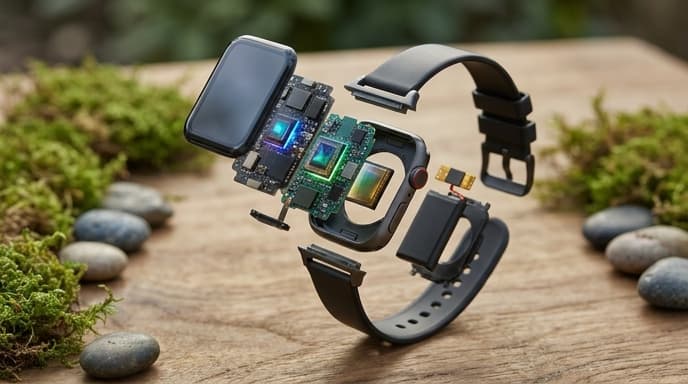
Understanding how these sensors function reveals the logic behind step counts, sleep analysis, and automatic workout detection. Here’s a breakdown of what each sensor does and how they combine to build a picture of your day.
The Accelerometer: Measuring Motion in a Straight Line
The primary sensor for activity tracking is the accelerometer. Its job is to measure linear acceleration—that is, changes in speed along a straight line. Most wearables use a 3-axis accelerometer, which means it can detect motion forward/backward, up/down, and side-to-side.
How does this translate to counting steps? Every time you take a step, your body moves with a distinct, repeating pattern of acceleration and deceleration. The accelerometer picks up on these rhythmic jolts. Sophisticated algorithms are programmed to recognize the signature of a human walking or running gait and filter out other, non-step movements, like driving on a bumpy road or simply moving your arm.
Beyond steps, the accelerometer also gauges the intensity of your movement. A gentle walk produces small acceleration signals, while a sprint produces large, rapid ones. This allows the device to estimate your activity level throughout the day.
The Gyroscope: Measuring Rotation and Orientation
While the accelerometer tracks linear motion, the gyroscope tracks angular velocity, or how fast an object is rotating. It also helps determine the device's orientation in space. Think of it as the sensor that knows which way is up.
A 3-axis gyroscope measures pitch (tilting up/down), roll (rotating sideways), and yaw (turning left/right). This is crucial for adding context to the data from the accelerometer. For example, the accelerometer might detect motion, but the gyroscope can tell the device if your wrist is flat (like when you're sleeping) or upright (like when you're walking).
This ability to track orientation is what allows for features like "raise to wake," where the screen turns on when you lift your wrist to look at it. The gyroscope detects that specific rotational movement.
Working Together: From Steps to Sleep Stages
The real power of these sensors is unleashed when their data is combined. By analyzing signals from both the accelerometer and the gyroscope, your device can build a much more detailed picture of your activities.
- Sleep Tracking: When you're asleep, you move very little. The accelerometer detects this lack of motion. The gyroscope provides additional data on your position and any tossing and turning. The algorithm analyzes the frequency and intensity of these movements throughout the night to estimate your sleep stages. Long periods of stillness are often classified as deep sleep, while periods with small movements might be light sleep.
- Automatic Workout Detection: The unique combination of linear and rotational movements can identify specific exercises. The rhythmic arm swing of running looks different from the circular motion of swimming or the wrist rotation of a tennis swing. By programming algorithms with these signature patterns, wearables can automatically recognize and log your workouts.
- Calorie Burn Estimation: The intensity of movement detected by both sensors is a key input for estimating how many calories you're burning during activity. More intense and complex movements register higher energy expenditure.
Frequently Asked Questions
Why is my step count different from my friend's, even if we walked together?
Step counting algorithms are tuned to filter out false positives. Differences in individual gait (how you walk), how you swing your arms, and even where you wear the device can lead to slight variations in what the sensor registers as a step.
Can these sensors track my location?
No. Accelerometers and gyroscopes only track motion and orientation. They do not know your geographical location. That requires a separate GPS sensor, which is included in some, but not all, wearables.
How do these sensors know I'm not just shaking my arm?
The algorithms are designed to look for the specific, repeating pattern of a human gait. Simple, random shaking doesn't match this signature and is typically filtered out. However, rhythmic, repetitive arm movements (like knitting or clapping) can sometimes be miscounted as steps.
Key Takeaways
- The accelerometer measures linear motion and is the primary sensor for counting steps.
- The gyroscope measures rotation and orientation, adding context to the accelerometer's data.
- Together, they allow your wearable to distinguish between different activities, such as walking, running, and sleeping.
- This combined data is used to estimate sleep stages by analyzing periods of stillness and movement.
- Algorithms are trained to recognize the unique motion signatures of different exercises for automatic workout detection.
Related Reading
- How Your Fitness Tracker Estimates Calorie Burn (and Why It's Just an Estimate)
- A Practical Guide to Your Sleep Stages: Optimizing Deep, Light, and REM Sleep
- What Your Wearable's Blood Oxygen (SpO2) Data Actually Means