
We often confuse familiarity with understanding. You might be able to recognize a term or a concept, but could you explain it, simply, to someone else? This is the gap the Feynman Technique is designed to close. Named after the Nobel Prize-winning physicist Richard Feynman, known for his ability to distill complex topics into simple analogies, this method is a powerful tool for learning anything more deeply.
It’s not just for physics. Whether you're trying to master a new programming language, understand a business strategy, or learn a historical event, this four-step process forces you to confront the details and find the holes in your knowledge. It moves you from passive review to active learning.
The 4 Steps of the Feynman Technique
The beauty of this technique lies in its simplicity. All you need is a piece of paper, a pen, and a topic you want to understand. The process forces you to articulate ideas, which is a far more effective way to learn than just reading or listening.
Step 1: Choose Your Concept and Study It
Start by picking the topic you want to learn. It could be anything from how photosynthesis works to the principles of cryptocurrency. Gather your source material—a textbook, articles, a video lecture—and study it as you normally would. Absorb the information, but don't just passively read. Take initial notes and try to grasp the main ideas.
Step 2: Teach It to a Child
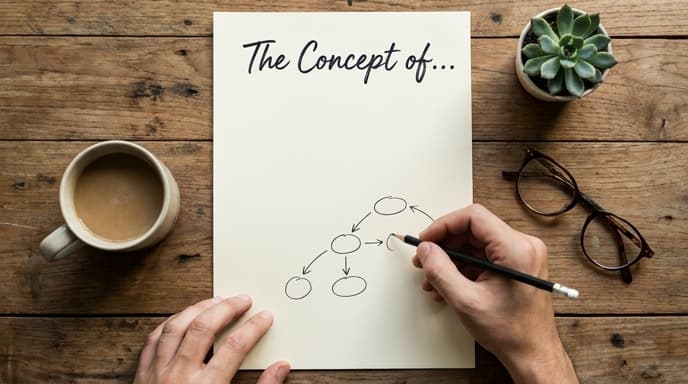
Now, take out a blank sheet of paper. At the top, write the name of the concept. Below, explain the concept from scratch as if you were teaching it to a 12-year-old. Use your own words, and avoid jargon and complex vocabulary. If you use a technical term, you must be able to break it down into simple language.
Using analogies and simple examples is key here. The constraint of simplicity is what makes this step so powerful. It immediately reveals where your understanding is fuzzy or reliant on memorized, but not understood, terminology.
Step 3: Identify Your Knowledge Gaps and Go Back to the Source
As you write out your explanation, you will inevitably get stuck. You'll find parts you can't explain simply, connections you can't make, or places where you have to resort to jargon. This is the most important part of the process. Every time you hesitate or feel your explanation is weak, you've identified a gap in your knowledge.
Circle these areas on your paper. They are your learning opportunities. Now, go back to your source material—your books, notes, or articles—and study those specific points until you can explain them in simple terms. This targeted review is far more efficient than re-reading everything.
Step 4: Review, Simplify, and Refine
Once you've filled in your knowledge gaps, return to your explanation. Read it aloud. Does it sound convoluted? Are there any parts that are not as clear as they could be? Your goal is to create a simple, clear, and cohesive narrative.
Refine your language, strengthen your analogies, and organize the points into a story that flows logically. If you can take a complex topic and articulate it on a single page in plain English, you have achieved a deep level of understanding.
Why This Method Works
The Feynman Technique is effective because it shifts you from passive learning to active recall and application. Instead of just highlighting text or re-reading notes, you are forced to process and re-articulate the information.
- It forces active learning: You can't explain something in simple terms without first understanding it yourself.
- It provides instant feedback: You know exactly where you're struggling the moment you can't explain a part of the concept.
- It improves memory: The process of retrieving information, making connections, and creating analogies builds stronger neural pathways.
Frequently Asked Questions
Do I actually have to teach it to someone?
No, the process is a thought experiment. Writing it down as if you were teaching someone is the key. The act of writing forces clarity. However, actually explaining it to a friend or colleague can be an excellent way to test your understanding.
How is this different from summarizing?
A summary can still use the complex language of the source material. The Feynman Technique's core requirement is to use simple language. This constraint forces a deeper level of processing and understanding, not just condensation.
Can I use this for any subject?
Yes. It is universally applicable. It works for scientific concepts, historical events, mathematical theorems, business frameworks, and technical skills. Any topic that can be explained can be learned with this technique.
Key Takeaways
- The Feynman Technique is a four-step method for learning any topic deeply.
- The core idea is to explain a concept in simple terms, as if to a child.
- This process quickly reveals the gaps in your understanding, allowing for targeted review.
- The steps are: 1. Study the topic, 2. Teach it simply, 3. Fill the gaps, 4. Refine the explanation.
- It's a powerful form of active recall that builds true comprehension, not just familiarity.
Related Reading
- How to Build a ‘Second Brain’ to Organize Your Digital Life
- Interleaving: The Counterintuitive Way to Learn Better
- The 80/20 Rule for Learning: Master Any Skill Faster