
Traditional note-taking is linear. We write from top to bottom, left to right, forcing our ideas into a rigid, sequential structure. But our brains don't work that way. We think in connections, with ideas radiating out from a central point. Mind mapping is a technique that embraces this natural, radiant thinking process, providing a powerful way to capture, organize, and explore your thoughts visually.
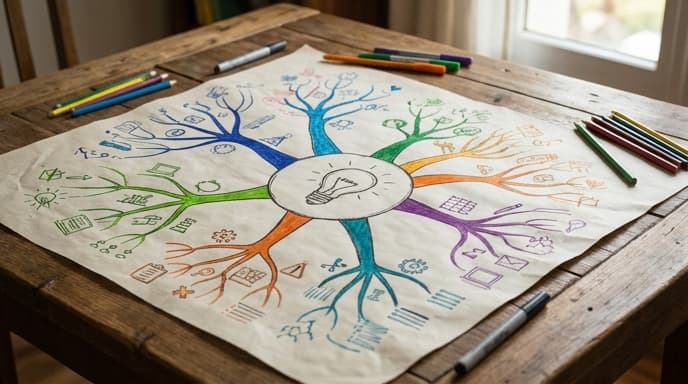
A mind map is a diagram used to visually organize information. It is hierarchical and shows relationships among pieces of the whole. By using a combination of keywords, colors, and images, mind maps can turn a long list of monotonous information into a colorful, memorable, and highly organized diagram that works in line with your brain's natural way of doing things.
The Core Principles of Mind Mapping
While you can be creative, effective mind maps generally follow a few core principles that make them easy to read and understand.
- Start with a central idea: Your main topic or subject is the starting point, placed in the center of the page.
- Use radiating branches: Major themes and ideas branch out directly from the central image. These are your primary branches.
- Add sub-branches: Supporting details and related ideas branch off from the primary branches, creating a nested structure.
- Use keywords: Each branch should ideally contain a single keyword or a very short phrase. This keeps the map clean and encourages concise thinking.
- Incorporate color and images: Using different colors for different branches and adding simple drawings can help stimulate your brain, improve memory, and make the map more engaging.
How to Create Your First Mind Map: A Step-by-Step Guide
The best way to learn is by doing. Grab a blank piece of paper (turn it sideways for more space), some colored pens, and follow these steps.
Step 1: Define Your Central Topic
Start in the center of your page. Write down your main subject and draw a circle or an image around it. For example, if you're planning a vacation, your central topic might be "Italy Trip." If you're studying for an exam, it might be "The Human Brain."
Step 2: Draw Your Main Branches
Think about the most important themes or categories related to your central topic. Draw thick branches radiating out from the center for each of these themes. For the "Italy Trip" example, your main branches might be: Cities, Budget, Activities, and Logistics.
Step 3: Add Keywords and Sub-Branches
Now, start adding detail. On each main branch, write a single keyword. From these main branches, draw thinner sub-branches for related ideas. For example, from the Cities branch, you might have sub-branches for Rome, Florence, and Venice. From the Rome sub-branch, you could add further branches for Colosseum, Vatican City, and Food Tour.
Step 4: Expand and Connect
Continue this process, adding more levels of detail as needed. Let your mind flow freely. Don't worry about perfection; the goal is to get your ideas down on paper. You can also draw lines or arrows to connect ideas on different branches, showing relationships across the map.
Step 5: Use Color and Images
Go back and add color to your branches. You could assign one color per main theme. Add small, simple drawings (icons or symbols) next to keywords to make them more memorable. This visual element is a key part of what makes mind mapping so effective for recall.
Digital vs. Pen and Paper
Creating a mind map by hand is a great way to start, as the physical act of drawing can aid thinking and memory. However, digital mind mapping tools offer advantages like easy editing, infinite space, and the ability to attach links and files. Many free and paid options are available, so you can experiment to see which you prefer.
Frequently Asked Questions
How is a mind map different from a concept map?
A mind map has a radial structure, with one central topic and branches radiating outwards. A concept map can have multiple hubs and complex relationships, with connecting lines that are labeled to explain the relationship between nodes. Mind maps are simpler and often better for brainstorming.
What can I use mind mapping for?
The applications are nearly endless. Common uses include brainstorming, taking notes in a meeting or lecture, planning projects, outlining essays or presentations, studying for exams, and setting personal goals.
Is there a right or wrong way to make a mind map?
While there are best practices, the most important rule is that it works for you. The goal is to create a clear visual representation of your thoughts. As long as it helps you think, learn, or create, it's a success.
Key Takeaways
- Mind mapping is a visual technique for organizing information that mirrors how the brain thinks.
- It uses a radial structure with a central topic, radiating branches, keywords, colors, and images.
- Creating a mind map helps with brainstorming, planning, note-taking, and memorization.
- The process involves starting with a central idea and progressively adding branches and sub-branches with details.
- Both pen-and-paper and digital tools are effective ways to create mind maps.
Related Reading
- The Feynman Technique: Learn Anything Faster by Explaining It Simply
- The 5-Minute Journal: A Simple Daily Practice for a Better Mindset
- How to Build a ‘Second Brain’ to Organize Your Digital Life