
You decide to start a new habit: exercising for 30 minutes every day. The first week is great. You feel motivated and don't miss a single session. Then, on the eighth day, life gets in the way. You're too tired, too busy, and you skip it. The perfect streak is broken. The next day, it's easier to skip again, and soon the habit is completely forgotten.
This all-or-nothing approach is why most habits fail. The solution is a simple but powerful mental model: the Two-Day Rule. The rule is straightforward: never miss two days in a row.
Why the Two-Day Rule Is So Effective
The power of the Two-Day Rule lies in what it prevents. One missed day is an anomaly, a part of life. Two missed days is the beginning of a new, negative habit. By focusing all your energy on not letting that second day slip, you protect the long-term trajectory of your progress.
This framework does two critical things:
- It builds resilience. It gives you permission to be human. You don't have to be perfect. You just have to be consistent. This removes the pressure that often leads to burnout and quitting.
- It preserves momentum. The hardest part of a habit is often starting over. The Two-Day Rule ensures you never have to. You're not starting from zero; you're just continuing on after a brief, one-day pause.
How to Implement the Two-Day Rule
Putting this rule into practice is simple. All you need is a way to track your habit. A physical calendar, a notebook, or a habit-tracking app will work perfectly.
Step 1: Choose One Habit to Track
Don't try to apply this to ten new habits at once. Start with the one that is most important to you right now. This could be anything: writing 500 words, meditating for 10 minutes, going to the gym, or practicing a musical instrument.
Step 2: Track Your Progress Visibly
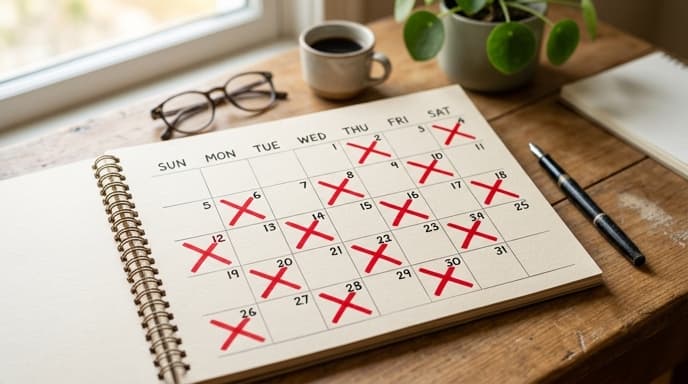
Each day you complete your habit, mark an 'X' on your calendar. The goal is to build a chain of Xs. This visual proof of your progress is a powerful motivator. This method is often called the 'Seinfeld Strategy'.
Step 3: Enforce the Rule
If you miss a day, that's okay. Circle that day on the calendar. Now, your single most important task for the following day is to get that 'X'. Do whatever it takes. Make the habit your top priority. Go to the gym for just 10 minutes. Write just one sentence. The goal isn't a perfect performance; the goal is to show up and break the chain of missed days.
Your New Mantra: Don't Break the Chain... of Two
The Two-Day Rule reframes your goal. You're no longer chasing an unbroken, perfect streak. You are simply focused on one thing: never letting a blank day be followed by another blank day. It's a forgiving system that prioritizes long-term consistency over short-term perfection, and that is the real secret to making habits that last.
Frequently Asked Questions
What if I get sick or go on vacation?
Life happens. If you know you'll be unable to perform your habit for a legitimate reason, you can pause it. The rule applies to your normal routine. The key is to be honest with yourself and not use this as a loophole for procrastination.
Does the size of the effort matter on the second day?
No. On the day after a missed day, the most important thing is to simply do the habit, even if it's a scaled-down version. If your habit is to run 5k, just putting on your shoes and running for 5 minutes is a victory. You've maintained the identity of someone who runs.
Can I apply this to breaking bad habits?
Yes. You can invert it. The goal would be to never indulge in a bad habit two days in a row. This can be a powerful way to reduce a negative behavior without the pressure of quitting cold turkey.
Key Takeaways
- The Two-Day Rule states that you should never miss your target habit two days in a row.
- It combats the all-or-nothing mindset that causes many people to quit.
- Missing one day is an accident; missing two days is the start of a new, negative habit.
- Track your habit visually on a calendar to motivate yourself.
- Focus on consistency over perfection for long-term success.
Related Reading
- The Power of Habit Stacking
- A Guide to Performing a Weekly Review
- How to Use Deliberate Practice to Accelerate Skill Growth