
Building a home gym often starts with a set of dumbbells, but buying a full rack with multiple weights is expensive and requires a significant amount of space. Adjustable dumbbells offer an elegant solution, consolidating an entire rack's worth of weights into a single pair. However, the market is filled with different designs and mechanisms, and choosing the right one is key to a safe and effective workout.
This guide will break down the most common types of adjustable dumbbells, what to look for in terms of features and build quality, and how to select the right weight range for your fitness goals. This will give you the confidence to invest in a versatile tool that will support your training for years to come.
How Adjustable Dumbbells Work: The Mechanisms
The core of any adjustable dumbbell is its mechanism for changing weights. Understanding how each type works will help you decide which is best for your workout style.
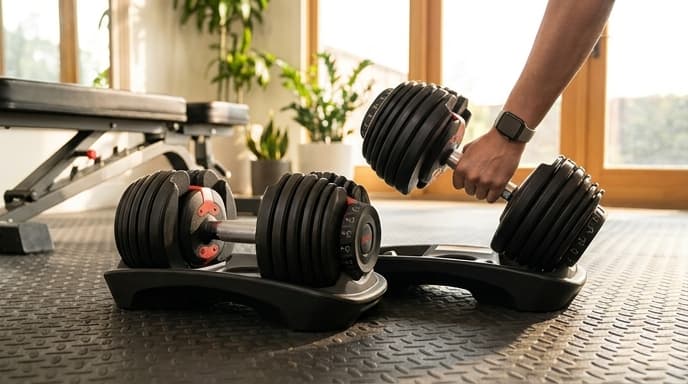
- Dial System: This is one of the most popular designs. The dumbbell rests in a cradle, and you turn a dial on each end to select your desired weight. When you lift the handle, it only picks up the selected plates, leaving the rest in the cradle. They are often fast and easy to adjust.
- Selector Pin System: Similar to the weight stack machines at a commercial gym, these dumbbells have a pin that you slide into a slot corresponding to a specific weight. They are typically very durable and secure.
- Twist-Lock System: With this design, you dock the dumbbell handle and simply twist it to select the weight. The mechanism is often contained within the handle itself, making for a compact and clean design.
What to Consider Before Buying
Beyond the core mechanism, several other factors will influence your decision. Thinking about these ahead of time will ensure you get a set that matches your needs.
Weight Range and Increments
Adjustable dumbbells come in various weight ranges, from those that max out around 25 pounds to heavy-duty sets that go up to 90 pounds or more per hand. Consider your current strength and future goals. It's often wise to buy a set that gives you room to grow.
Also, look at the weight increments. How small are the jumps between weights? Smaller increments (e.g., 2.5 pounds) are better for steady progressive overload, especially on smaller muscle groups.
Durability and Materials
You are lifting these weights over your head, so safety and durability are paramount. Look for models with metal plates and a secure locking mechanism. Read reviews and look for feedback on how well the dumbbells hold up over time. Cheaper models with lots of plastic parts may not be a good long-term investment. Also, consider the handle's grip and ergonomics for comfort during your lifts.
Frequently Asked Questions
Are adjustable dumbbells safe?
Yes, when made by a reputable manufacturer and used correctly, they are very safe. The locking mechanisms are designed to be secure. The biggest risk comes from dropping them, as the complex internal parts can be damaged more easily than a solid iron dumbbell.
Can you do all the same exercises with them?
For the most part, yes. You can perform presses, rows, curls, lunges, and more. Their shape, which can sometimes be bulkier than traditional dumbbells, might make a few specific movements slightly awkward, but this is rarely a significant issue.
Are they worth the cost?
While the initial investment can seem high, they are almost always more cost-effective than buying an equivalent range of individual dumbbells. When you factor in the space they save, the value proposition is excellent for most home gym owners.
Key Takeaways
- They save space and money: Adjustable dumbbells are a compact and cost-effective alternative to a full rack of traditional dumbbells.
- Understand the mechanism: Choose between dial, selector pin, or twist-lock systems based on ease of use and durability.
- Check the weight range and increments: Select a range that allows for future progress and look for smaller increments to support steady progression.
- Prioritize build quality: Look for metal components and a secure locking system for safety and longevity.
- Never drop them: The internal adjustment mechanisms can be damaged by impact.
Related Reading
- A Practical Guide to Autoregulation in Your Training
- Master the Pull-Up: A 5-Phase Progression for Beginners
- How to Use Rate of Perceived Exertion (RPE) to Guide Your Training