
Most fitness watches and trackers come with a built-in optical heart rate sensor. It's incredibly convenient for tracking your heart rate 24/7, from sleep to your daily walk. But when it comes to high-intensity training, you may have noticed the numbers seem to lag or jump around. This is where a chest strap monitor often comes out on top.
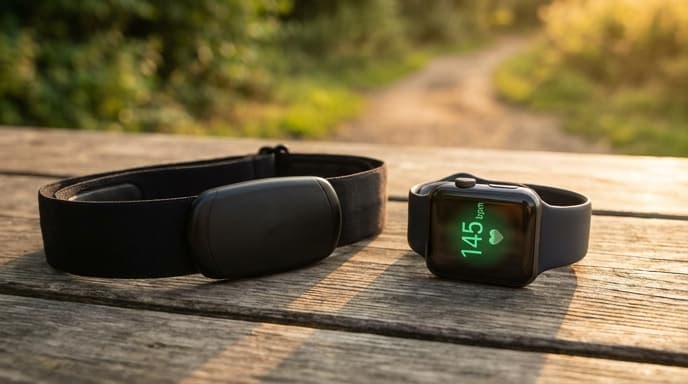
Understanding how each technology works will help you decide if your watch is good enough for your training, or if it's time to level up your data accuracy with a dedicated chest strap.
How Wrist-Based Optical Sensors Work (PPG)
The sensor on the back of your watch uses a technology called photoplethysmography (PPG). It shines a green light onto your skin, which is reflected by your blood. As your heart beats, the volume of blood flowing through your wrist changes, and the sensor measures the changes in light reflection to calculate your heart rate.
This method is great for steady-state activities like walking, jogging, or cycling at a consistent pace. However, its accuracy can be affected by several factors: a loose watch band, rapid arm movements (like in HIIT or weightlifting), skin tone, and tattoos.
How Chest Strap Monitors Work (ECG)
A chest strap monitor works like a simplified electrocardiogram (ECG or EKG). It has electrodes that sit against your skin and measure the tiny electrical signals generated by your heart as it contracts. This is a direct measurement of your heart's activity, not an estimate based on blood flow.
Because it's measuring the signal directly from the source and is secured tightly around your torso, it's far less susceptible to the motion-related errors that affect optical sensors. This makes it the gold standard for accuracy, especially when your heart rate is changing rapidly.
When to Choose One Over the Other
So, which one is right for you? It depends entirely on your training style and data needs.
Choose a Wrist-Based Optical Sensor For:
- All-Day Tracking: Perfect for monitoring resting heart rate, sleep, and general daily activity.
- Convenience: It's always on you, with nothing extra to wear or charge.
- Steady-State Cardio: It's generally reliable for activities like long runs, cycling, or hiking where your heart rate is relatively stable.
Choose a Chest Strap Monitor For:
- High-Intensity Interval Training (HIIT): It responds much faster to rapid changes in heart rate, giving you a true picture of your effort and recovery.
- Weightlifting: Wrist flexion and muscle tension can throw off optical sensors. A chest strap is unaffected.
- Maximum Accuracy: If you base your training zones on precise heart rate data, a chest strap is the most reliable tool. Most also capture Heart Rate Variability (HRV) data more accurately.
Frequently Asked Questions
Can I use a chest strap with my current fitness watch?
Yes, most modern chest straps from major brands use Bluetooth and/or ANT+ to connect to a wide variety of fitness watches, smartphone apps, and even smart gym equipment like treadmills and stationary bikes.
Are chest straps uncomfortable?
Modern chest straps are made of soft, flexible fabric and are quite comfortable once you get used to them. You need to wear them snugly for the electrodes to make good contact, but they shouldn't be restrictive. Proper fit is key.
Why does my watch sometimes give a ridiculously high or low reading?
This is often due to 'cadence lock,' where an optical sensor mistakenly picks up the rhythm of your running or cycling cadence instead of your heart rate. A loose fit or cold weather (which reduces blood flow to the wrist) can also cause errors.
Key Takeaways
- Wrist-based sensors (PPG) use light to measure blood flow and are convenient for 24/7 tracking and steady-state exercise.
- Chest straps (ECG) measure the heart's electrical signals directly, making them more accurate, especially during intense exercise.
- For HIIT, weightlifting, and precise training zone data, a chest strap is the superior choice for accuracy and responsiveness.
- For general fitness, sleep tracking, and convenience, the optical sensor on your watch is a powerful and sufficient tool.
- Most chest straps can pair with your existing watch or phone, giving you the best of both worlds.
Related Reading
- Readiness Scores Explained: The Science Behind Whoop and Oura’s Daily Numbers
- A Practical Guide to Autoregulation in Your Training
- VO2 Max Explained: A Guide to Measuring and Improving Your Aerobic Fitness