
A quality gaming headset is a non-negotiable part of any serious setup. It provides immersive sound that can help you pinpoint enemy footsteps and clear communication that keeps your team coordinated. But with endless options and technical jargon, choosing the right one can be daunting.
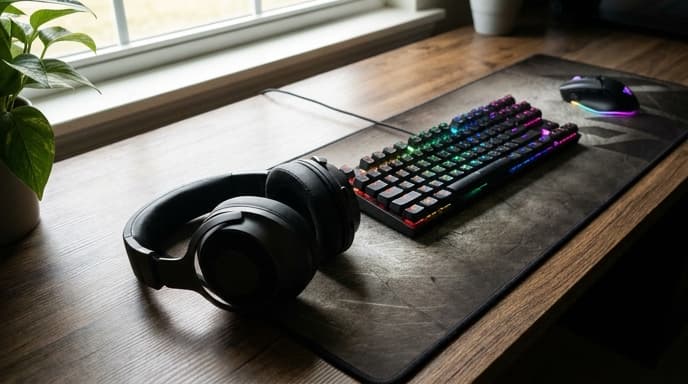
This guide will demystify the key features of gaming headsets. We'll cover the critical wired vs. wireless debate, what you need to know about sound quality, and how to ensure your voice is heard loud and clear.
The First Choice: Wired vs. Wireless
This is the biggest decision you'll make, and it comes down to a trade-off between freedom and flawless connection.
Wired headsets connect via a USB or 3.5mm audio jack. Their biggest advantage is a zero-latency, interference-free connection. You never have to worry about charging them, and they generally offer the best possible audio quality for the price. The only downside is the cable, which can get in the way.
Wireless headsets offer the incredible freedom of being untethered from your desk. They typically connect via a dedicated 2.4GHz USB dongle for a low-latency connection (avoid Bluetooth for serious gaming due to higher latency). The trade-offs are the need to keep them charged and a higher price for performance comparable to a wired model.
Sound Quality: Stereo, Surround, and Design
Don't get too caught up in marketing terms like '7.1 Surround Sound.' Here's what actually matters.
- Stereo vs. Virtual Surround: Nearly all headsets are physically stereo, with one driver per ear. 'Surround sound' is achieved through software that processes the audio to simulate a multi-speaker setup. While it can be immersive, many competitive players prefer to use pure stereo or the game's own built-in audio processing for the most accurate positional cues.
- Open-Back vs. Closed-Back: This refers to the design of the earcups. Closed-back headsets have solid cups that isolate you from outside noise and prevent your game audio from leaking out. This is great for noisy environments. Open-back headsets have perforated earcups that allow air and sound to pass through. This creates a wider, more natural 'soundstage' but offers no noise isolation. They are excellent for quiet environments where immersion is the top priority.
The Microphone: Being Heard Clearly
A good microphone is what separates a gaming headset from a pair of headphones. Your teammates need to hear your callouts without a lot of background noise.
Look for a headset with a noise-cancelling microphone. This technology helps filter out ambient sounds like your keyboard clicks or a nearby fan, focusing only on your voice. Also, consider the physical design. A detachable or flip-to-mute microphone is a great convenience feature for when you're not in a voice chat.
Frequently Asked Questions
Is 7.1 surround sound in a headset a gimmick?
It's not entirely a gimmick, but its effectiveness can be overstated. The virtual surround sound is created by software, not by placing multiple speakers in the earcup. Some players find it immersive, while others find it muddies the audio and prefer the clarity of a good stereo signal for competitive play.
Do I need to spend a lot of money on a gaming headset?
Not necessarily. While premium headsets offer better build quality, comfort, and features, you can find excellent wired headsets with great audio and clear microphones at very reasonable price points. Focus on the core features—sound, mic, and comfort—before looking at extras.
What is 'sidetone'?
Sidetone, also called mic monitoring, is a feature that feeds a little of your own voice from the microphone back into your earpieces. This helps you hear how you sound and prevents you from shouting because you can't hear yourself speak due to the noise isolation of the headset.
Key Takeaways
- Wired headsets offer a reliable, zero-latency connection, while wireless offers freedom at the cost of charging and a higher price.
- For wireless, choose a model with a 2.4GHz dongle, not Bluetooth, to minimize audio lag.
- A quality stereo signal is often better for competitive gaming than virtual surround sound, which can be a matter of personal preference.
- Closed-back headsets isolate noise, while open-back models offer a more natural, immersive soundstage in quiet rooms.
- A noise-cancelling microphone is essential for clear team communication.
Related Reading
- Gaming Mouse DPI and Polling Rate Explained
- How to Choose an Ergonomic Gaming Chair for Health and Comfort
- A Practical Guide to Buying a High-Refresh-Rate Monitor