
While mobile wallets use fingerprint and facial scans to authorize purchases, physical payment cards are adopting similar hardware. The emergence of biometric payment cards adds a miniature capacitive fingerprint reader directly into standard ISO-dimension plastic, pairing physical card acceptance with biometric checks.
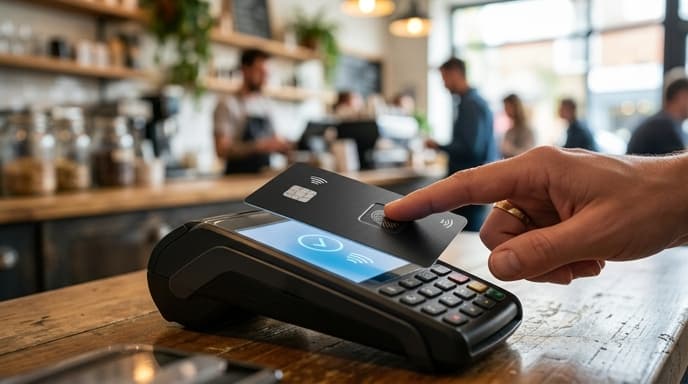
Understanding how these cards capture touch inputs, draw power, and secure biological data shows how payment cards are adjusting to prevent physical theft.
The Match-on-Card Architecture: Keeping Biometrics Local
The primary security rule of a biometric smart card is local containment. The card never transmits your fingerprint image or a digital template to the merchant's point-of-sale terminal, your issuing bank, or a centralized cloud database.
During setup using an enrollment sleeve or mobile banking app, the card converts your fingerprint ridges into a cryptographic hash. This reference template is burned directly into the card's Secure Element. When you tap or insert the card to pay, the sensor reads your finger and executes a "match-on-card" comparison inside the silicon chip. If the hashes match, the Secure Element approves the standard EMV transaction cryptogram.
RF Energy Harvesting: Operating Without an Internal Battery
Fitting a fingerprint sensor, a secure microprocessor, and an internal battery into a flexible 0.76mm piece of plastic presents physical engineering hurdles. Most biometric payment cards do not contain a chemical battery.
- Contactless operation: The card harvests electrical power directly from the radio frequency (RF) field emitted by the merchant's NFC terminal using electromagnetic induction.
- Ultra-low-power sensors: The capacitive fingerprint sensor runs on micro-joules of energy, waking up, scanning your ridge pattern, and authenticating within a fraction of a second during a tap.
- Contact interfaces: When inserted into older non-NFC chip terminals, the card draws power directly from the terminal's physical contact pins.
Overcoming Contactless Transaction Spending Limits
In many regions, payment networks set hard limits on contactless transactions that do not require a PIN to minimize losses from lost or stolen cards. Once a purchase exceeds that limit, the terminal requires you to insert the card and enter a four-digit PIN.
Because biometric cards verify identity directly on the physical card through your enrolled fingerprint, they satisfy Strong Customer Authentication (SCA) requirements. This allows high-value transactions to complete with a tap without requiring you to use public terminal keypads, while maintaining baseline protection against physical card theft.
Frequently Asked Questions
What happens if the biometric sensor fails to read my finger?
If your finger is wet, scarred, or positioned incorrectly, the card falls back to standard payment protocols. The point-of-sale terminal prompts you to enter your standard four-digit PIN on the terminal keypad.
Can someone steal my fingerprint template if they steal the card?
No. The fingerprint data is stored as an irreversible cryptographic template inside the hardware Secure Element, protected by the same hardware defenses that secure master EMV encryption keys.
Are biometric cards more fragile than standard debit or credit cards?
Biometric cards meet standard ISO tests for bending and torsional stress. However, severe bending can damage the internal copper induction antenna or the wiring of the capacitive touch grid.
Key Takeaways
- Biometric payment cards handle fingerprint matching entirely inside the on-card Secure Element.
- No biological templates are transmitted over payment networks or saved in bank databases.
- Energy harvesting draws power from terminal NFC fields, eliminating the need for internal batteries.
- On-card biometric checks allow users to bypass standard contactless spending limits.
- Terminal PIN entry remains available as a fallback if the sensor cannot read your print.
Related Reading
- Understanding Payment Card EMV Chips: Offline Counters vs. Online Authorizations
- NFC Dynamic Cryptograms: Why In-Store Mobile Payments Beat Physical Cards
- Hardware Tokenization in Wearables: NFC Security in Smartwatches and Rings