
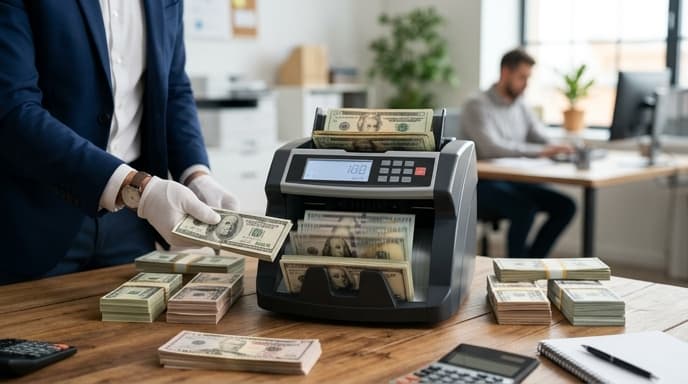
Envelope budgeting, sinking funds, and cash-stuffing systems involve handling large stacks of physical currency. Counting bills by hand takes time and introduces calculation mistakes. Cash counter machines bring commercial counting accuracy to home budgeting, but choosing the right model requires understanding feed mechanics and sensor types.
Selecting the wrong machine can leave you with constant paper jams on worn currency or incorrect counts on mixed stacks.
Basic Piece Counters vs. CIS Value Discriminators
The most important hardware distinction is the difference between a simple piece counter and an optical value discriminator:
- Basic piece counters: Budget machines use simple light sensors to count how many individual paper sheets pass through the wheels. They do not know what denomination a bill is. Feeding five $20 bills and five $100 bills returns a count of "10 bills," leaving you to add up the dollar total manually. A rogue $1 bill hidden inside a stack of $20s will also be counted as a $20.
- Contact Image Sensor (CIS) value discriminators: Advanced machines use one or two Contact Image Sensors. As currency moves through, the CIS scans both sides of every note, identifying the denomination, orientation, and serial numbers. You can drop a mixed stack of $1, $5, $20, and $100 bills into the hopper, and the machine displays an itemized total broken down by denomination.
Sensor Specs: UV, MG, and IR Counterfeit Verification
Even for personal finance sorting, checking note validity matters when handling cash from private transactions. Look for machines with multi-spectrum detection sensors:
- Ultraviolet (UV) sensors: Genuine currency paper contains chemicals that do not glow under UV light, whereas standard copy paper fluoresces brightly. UV sensors flag basic counterfeits printed on standard paper.
- Magnetic (MG) sensors: Authentic banknotes use ink formulated with magnetic particles on specific portraits, letters, and edges. MG read heads verify these magnetic traces as notes pass over the track.
- Infrared (IR) sensors: Modern banknotes use infrared-absorbing and infrared-reflecting inks placed at specific points. IR arrays verify that paper opacity and ink reflectance match central bank parameters.
Feeder Mechanics: Friction Feed Quality and Hopper Orientation
Circulating currency is often creased, limp, or worn. Feeding reliability depends on the mechanical design of the hopper:
- Front-loading vs. back-loading hoppers: Back-loading (vertical gravity) hoppers are common on budget counters. They require neatly squared stacks of crisp bills and jam easily on bent corners. Front-loading (horizontal) hoppers match commercial bank equipment, allowing continuous feeding of mixed-condition bills while running.
- Feed rollers: Heavy-duty silicone or textured rubber rollers pull worn notes smoothly without tearing edges. Look for units with a manual tension adjustment screw to fine-tune the roller gap for thick or crisp paper.
- Batching functions (BATCH): Essential for cash envelopes. This setting pauses the feed once a target count is reached (such as 20 bills). You can fill a specific sinking fund envelope cleanly before touching the button to feed the next batch.
Frequently Asked Questions
Can a bill counter sort physical bills into separate output trays?
Single-pocket machines count and value mixed stacks, but they must stop running when they encounter a different denomination. To separate mixed bills into different physical stacks continuously, you need a dual-pocket machine with a dedicated reject pocket.
How do I clean dust out of a cash counter?
Cash sheds paper fibers and skin oils. Clean the optical sensors, CIS lenses, and magnetic heads weekly using a can of compressed air and a microfiber cloth dampened with isopropyl alcohol.
Why does my counter show an 'E-01' or half-sheet error frequently?
Feed errors usually mean the hopper tension dial is too loose, allowing multiple notes to pull through at once. Turn the tension knob clockwise to narrow the gap so only one bill enters the rollers at a time.
Key Takeaways
- Basic piece counters only count sheets; CIS value discriminators read denominations and calculate mixed dollar totals.
- Multi-sensor arrays using UV, MG, and IR detect counterfeit notes and miscut paper.
- Front-loading hoppers feed circulated, crumpled bills more reliably than vertical back-loading designs.
- Batching features let you set preset bundle counts to fill budget envelopes quickly.
- Regular cleaning of optical sensors prevents paper dust from causing false jams and miscounts.
Related Reading
- Envelope Budgeting Apps: Evaluating Zero-Based vs Category Accrual Software
- The Moving Expense Sinking Fund Blueprint: Avoiding the Relocation Debt Trap
- Cash-Back vs Travel Reward Cards: Evaluating Break-Even Redemption Structures