
Cash stuffing, sinking funds, and envelope budgeting rely on accurate accounting for every physical dollar and cent. If you manage cash income or regularly wrap change, using reliable coin sorters for cash budgeting eliminates manual counting and catches miscalculated totals.
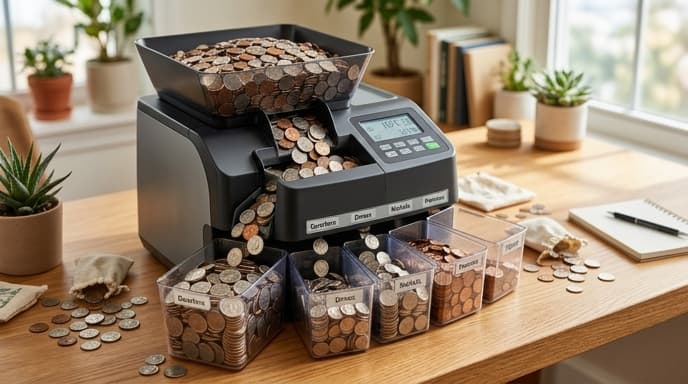
Cheap plastic sorters often jam on worn or dirty coins. Choosing a model with a motorized disc and optical counting keeps sorting fast and reliable.
Sorting Mechanics: Gravity Slopes vs Motorized Discs
The mechanical difference between toy sorters and dependable equipment comes down to how coins are guided into their tubes.
Gravity-Fed Chutes (Low Reliability)
Inexpensive sorters use sloped plastic ramps. Coins slide down by gravity, falling into cutouts sized for each denomination. Residue, surface oxidation, or slightly bent coins easily catch on the track, causing backups that require taking the unit apart.
Motorized Horizontal Discs (High Reliability)
Better units use a motorized spinning disc at the bottom of the collection hopper. As it rotates, centrifugal force pushes coins against an outer rim fitted with mechanical size gates. The continuous motor drive keeps coins moving through the gates without sticking.
Counting Accuracy: Mechanical Switches vs Infrared Sensors
Tracking the exact total inside the tubes depends on how the machine registers each coin as it drops.
- Physical Micro-Switches: Basic counters use spring-loaded plastic levers in each drop tube. Over time, the springs weaken, leading to missed counts or double counts when coins drop in rapid succession.
- Infrared Optical Beam Sensors: Better machines use dual infrared sensors across each channel. As a coin drops through, it breaks the light beam. An internal processor records the drop instantly and updates the running dollar total on the screen.
Motor Torque, Hopper Size, and Jam Recovery
Moving a few pounds of metal requires a motor with enough torque to avoid stalling.
- Hopper Capacity: Sorters with 100-coin bowls need constant reloading. Look for hoppers that hold 300 to 500 coins so you can pour in an entire jar at once.
- Reverse Drive Functions: Jams happen when bent coins, tokens, or debris slip in. Pick a machine with a reverse switch so you can clear the disc without turning it upside down and spilling sorted tubes.
- Direct Tube Roll Filling: Check that the unit includes tube attachments that hold standard paper wrappers, letting you sort and roll in a single step.
Frequently Asked Questions
Why do coin counters misidentify modern pennies from older ones?
Pennies made before 1982 are 95% copper, while newer ones are mostly zinc. Standard dimensional sorters group them identically by size, but counters that rely on internal scales can miscount them due to the weight difference.
Can foreign or bent coins damage the internal sorting discs?
Yes. Severely warped coins can wedge under the disc and stall the motor. Scan through your coins and pick out bent metal, tokens, and foreign change before filling the hopper.
How do I maintain accurate counts over long-term ownership?
Circulating coins leave behind grime and metal dust. Unplug the machine once a month and blow out the optical sensors with compressed air, or wipe them with a dry swab.
Key Takeaways
- Avoid passive gravity-fed sorting chutes; motorized horizontal discs prevent constant feed jams.
- Opt for dual infrared optical counting sensors over fragile mechanical click switches.
- Look for hoppers supporting at least 300 coins to minimize manual feed management.
- Prioritize machines with motor reverse functions to easily clear accidental jams.
- Ensure the unit features programmable batch stops that pause the motor exactly when a standard coin wrapper is full.
Related Reading
- Envelope Budgeting Apps: Evaluating Zero-Based vs Category Accrual Software
- The $1,000 Starter Buffer: Bridging Paychecks Without Credit Cards
- The Discretionary Spending Cool-Down Routine: How to Break Impulse Buying Loops