
Original financial instruments—such as deeds, physical stock certificates, vehicle titles, and estate trusts—need protection from structure fires and water damage. Buying fireproof document safes for financial records requires checking lab certifications instead of trusting retail packaging claims.
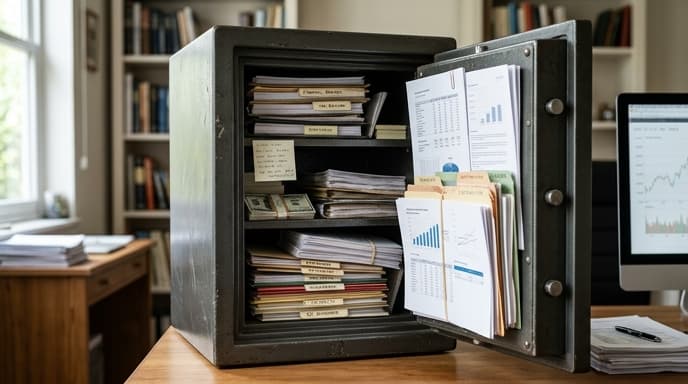
Safes labeled "fire resistant" without an independent rating offer unknown protection. Knowing how testing labs measure heat exposure ensures you pick the right container for paper or digital media.
Decoding the UL 72 Classification Standard
Underwriters Laboratories (UL) tests storage containers against the UL 72 standard. Ratings depend on two criteria: maximum internal temperature and the duration of heat exposure.
- UL Class 350 (Paper Records): Paper chars and catches fire around 451°F (233°C). A Class 350 safe keeps internal temperatures below 350°F (177°C) when exposed to furnace temperatures over 1,700°F. Common ratings cover 1-hour or 2-hour durations.
- UL Class 125 (Digital Storage and Media): Flash drives, external SSDs, and hardware security keys can lose data or warp above 125°F (52°C) or 80% relative humidity. A standard paper safe gets hot enough to ruin digital media; electronic records require a Class 125 safe.
The Water and Steam Trap in Fire Suppression
Putting out a structure fire takes thousands of gallons of water. At the same time, standard fire safe insulation works by releasing chemically bound moisture as cooling steam.
Why Moisture Barriers Matter for Sensitive Paper
Hydrated insulation can drive internal relative humidity near 100% during a fire. Without a proper barrier, old deeds, certificates, and handwritten documents can soften into pulp.
- Seal paper inside heat-resistant mylar pouches or a secondary waterproof box inside the safe.
- Look for independent ETL or UL water-submersion ratings confirming the door gasket keeps standing water out.
Lock Mechanisms and Anchoring Trade-Offs
A safe light enough to carry into a closet is light enough for an intruder to carry out the door.
Bolting a safe to a concrete subfloor stops someone from hauling it away. However, drilling through the exterior shell and insulation can void fire protection unless you use a factory bolt-down kit equipped with thermal grommets.
Frequently Asked Questions
Can I safely store a hardware cryptocurrency wallet in a UL Class 350 safe?
No. A UL Class 350 safe allows internal temperatures to climb to 350°F, which can melt solder joints, plastic casings, and flash storage chips. Use a Class 125 media safe or a stamped steel backup plate instead.
What is the difference between a fire safe and a burglary safe?
Fire safes use thin steel shells packed with hydrated gypsum to absorb heat. Burglary safes use thick plate steel and heavy relocking bolts engineered to resist pry bars, drills, and torches.
How often do the internal door gaskets on waterproof safes need replacement?
Rubber and neoprene seals dry out over time. Check the gasket yearly for cracking, and apply a thin layer of silicone lubricant if the manufacturer recommends it.
Key Takeaways
- Look for UL 72 or accredited ETL certifications; avoid unverified manufacturer fire claims.
- UL Class 350 maintains interior temperatures under 350°F, protecting paper bonds and deeds.
- Digital media, flash drives, and security keys require a dedicated UL Class 125 rated enclosure.
- Use moisture-sealed sleeves to prevent fire-insulation steam from degrading historic paper documents.
- Ensure bolt-down kits are engineered by the manufacturer to preserve thermal integrity.
Related Reading
- Air-Gapped Financial Backups: Comparing Encrypted USB vs Steel Seed Storage
- Hardware-Encrypted USB Drives: How to Pick Cold Storage for Financial Records
- Dedicated Document Scanners for Tax Records: Key Specs to Look For