
Standard steel lockboxes offer no thermal insulation during a house fire. Deeds, physical stock certificates, tax files, and paper cryptocurrency backups require specialized thermal barriers to survive sustained furnace heat. Fireproof safes for financial documents rely on chemical insulation to delay internal heating, but retail marketing often obscures actual test standards.
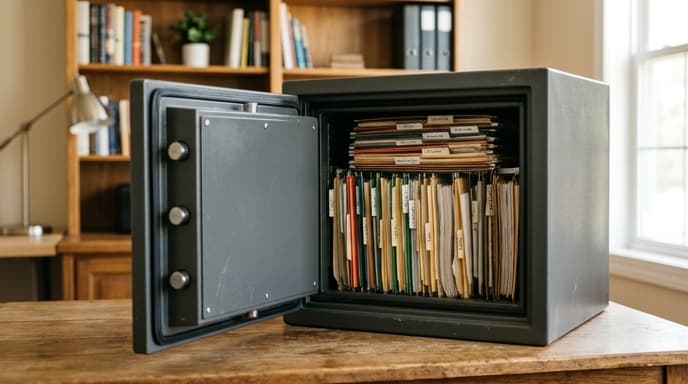
Paper begins charring at roughly 405°F (207°C) and catches fire around 450°F (232°C). Protecting documents requires understanding Underwriters Laboratories (UL) fire tiers, internal humidity, and safe anchoring methods.
Decoding Fire Ratings: Why UL 72 Class 350 Is the Baseline
Independent safety ratings track the internal temperature of a safe inside a commercial test furnace.
- UL 72 Class 350 (1-Hour or 2-Hour): The standard certification for paper documents. It guarantees that when external furnace heat reaches 1,700°F (927°C) for one hour, or 1,850°F (1,010°C) for two hours, the interior stays below 350°F (177°C).
- Class 125 for digital media: USB flash drives, hard drives, and magnetic media fail around 120°F to 125°F. A Class 350 paper safe gets far too hot for digital media; storing drives requires a Class 125 rated container with thicker thermal insulation.
- Impact ratings: When structural floors fail in a fire, safes drop onto concrete foundations. A UL 30-foot drop test rating confirms the outer shell and insulation will not crack open on impact.
The Moisture Trap: Why Fire Insulation Generates Humidity
Most fireproof safes use insulation made from hydrate composites, such as gypsum concrete containing chemically bound water molecules. Under fire conditions, the heat turns this bound water into steam inside the chamber, capping internal temperatures near the boiling point of water.
During normal storage, however, this concrete releases small amounts of water vapor into the airtight safe. Over several months, stored documents can grow mold, stick together, or suffer ink degradation.
Keep documents inside heavy polyethylene zip bags, and keep a rechargeable silica gel canister inside the safe. Check and dry the desiccant every three to six months depending on room humidity.
Water Ingress and Anchoring Vulnerabilities
Fire hoses pump hundreds of gallons of water per minute into a burning building, flooding basements and lower levels.
- Submersion ratings: Check for independent verification (such as ETL or UL) covering water submersion. A closed-cell rubber compression gasket around the door stops runoff from soaking folders.
- Bolt-down kits: Safes weighing under 150 pounds are easy targets for theft. However, drilling holes through the fire insulation breaks both the thermal envelope and the water seal unless the safe includes a factory-engineered bolt channel with sealed silicone washers.
- Locking mechanism reliability: Electronic keypads provide quick entry but need external battery terminal contacts in case internal batteries run out. Mechanical combination dials need no batteries, though they open more slowly.
Frequently Asked Questions
Can I store hardware wallets and USB thumb drives in a standard paper fire safe?
No. UL Class 350 safes can reach internal temperatures of 350°F, melting plastic housings and corrupting flash memory. Place digital drives inside a UL Class 125 media container before putting them inside a paper safe.
Why do paper documents feel damp inside a fireproof safe?
Insulating compounds contain bound water that evaporates slowly inside the airtight chamber. Place a metal silica gel canister inside the safe to absorb this moisture.
Are home gun safes equivalent to UL document safes?
No. Most residential gun safes focus on pry resistance and use thin drywall sheets for basic heat resistance. Most do not hold UL 72 Class 350 certifications and will exceed paper charring temperatures during a fire.
Key Takeaways
- Look for a UL 72 Class 350 certification to keep interior temperatures below the char point of paper.
- Digital storage devices need UL Class 125 containers; standard paper safes get hot enough to destroy flash memory.
- Hydrate insulation releases moisture inside sealed safes, requiring desiccant packs to stop mold.
- Verify flood and water seals to prevent fire hose runoff from soaking records.
- Anchor safes using factory-sealed bolt channels to keep the thermal and waterproof barrier intact.
Related Reading
- Air-Gapped Financial Backups: Comparing Encrypted USB vs Steel Seed Storage
- Dedicated Document Scanners for Tax Records: Key Specs to Look For
- Hardware-Encrypted USB Drives: How to Pick Cold Storage for Financial Records