
Tossing tax returns, monthly brokerage summaries, or voided checks into standard recycling leaves account numbers readable to anyone who opens the bin. Choosing reliable paper shredders for financial records comes down to mechanical specifications rather than brand claims.
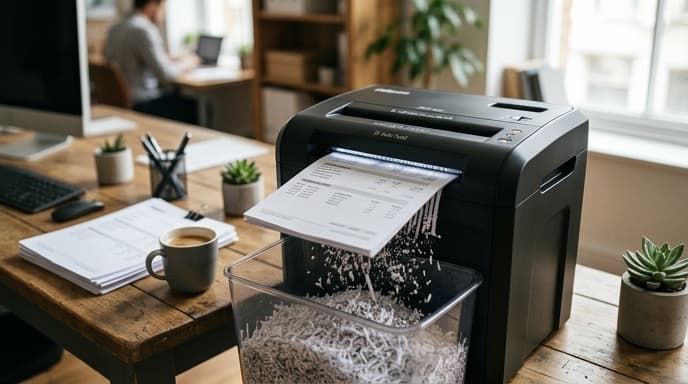
A shredder built for junk mail tends to stall on heavy cardstock or multi-page statements. Matching cut dimensions, duty cycles, and sensors to your workload ensures personal financial data cannot be recovered.
Understanding DIN 66399 Security Levels
Document shredding performance is standardized under the international DIN 66399 standard. It rates particle dimensions from P-1 to P-7, where higher numbers indicate smaller fragments.
- P-1 and P-2 (Strip-Cut): These machines slice pages into vertical ribbons roughly 6mm to 12mm wide. Strip-cut models are inadequate for financial documents because basic reconstruction software can reassemble the strips.
- P-3 and P-4 (Cross-Cut): These shredders cut both vertically and horizontally into small rectangles. A P-4 rating produces particles smaller than 160 square millimeters, which works for utility bills and general mail.
- P-5 and P-6 (Micro-Cut): A P-5 unit turns a single sheet into more than 2,000 diamond-shaped particles under 30 square millimeters. For tax worksheets, credit applications, and investment reports, P-5 micro-cut is the practical baseline.
Duty Cycle and Sheet Capacity Specs
Consumer shredders frequently shut down from thermal overload when users feed them years of back statements in one sitting.
Continuous Run Time vs Cool-Down Periods
Every motor has a duty cycle rating: active run time versus required rest time. Entry-level shredders often run for 3 minutes and need 30 minutes to cool down. If you purge ledgers quarterly or annually, look for 10 to 20 minutes of continuous run time backed by fan-assisted cooling.
Throat Width and Pass-Through Capacity
Pass-through ratings specify how many sheets the cutting cylinder handles at once without binding. Budget units often stop at 6 sheets, while feed systems rated for 12 to 18 sheets take folded notices and stapled packets without constant prep work.
Mechanical Features That Matter and What to Skip
Packaging often features add-ons that raise the price without helping destroy data. Focus on core mechanics.
- Look for reverse auto-clear: Sensors that detect resistance and reverse the gears prevent motor burnout on thick batches.
- Look for separate credit card blades: Hardened carbon steel cutters dedicated to plastic protect primary paper blades from dulling.
- Skip high-capacity pull-out bins without casters: Shredded paper gets heavy fast, and unwheeled bins are awkward to lift and empty.
- Skip integrated bin compaction paddles: Manual compression levers tend to bend plastic housings and block optical full-bin sensors.
Frequently Asked Questions
Can a P-4 cross-cut shredder adequately protect bank statements?
A P-4 shredder is fine for routine household banking statements. For pages listing full Social Security numbers or primary account keys, P-5 micro-cut offers an extra layer of physical security.
Why do shredders overheat so quickly during annual document purges?
Compact shredder housings use small universal motors without dedicated heat sinks. Thermal switches shut off power before ambient heat melts internal nylon drive gears.
Do credit card cutting slots destroy magnetic strips and chips?
Dedicated slots cut plastic into wide pieces that break the magnetic stripe. Check that the EMV chip or internal antenna is cut through before tossing the scrap.
Key Takeaways
- Never rely on strip-cut (P-1 or P-2) shredders for records showing bank numbers or identifiers.
- DIN P-4 cross-cut is the baseline for monthly bills; DIN P-5 micro-cut is ideal for tax and credit filings.
- Check the duty cycle ratio: a 10-minute continuous run time prevents prolonged thermal pauses.
- Hardened steel cutting blocks accept staples and clips without damaging blade alignment.
- Regular lubrication using shredder oil sheets preserves motor torque and prevents paper dust build-up.
Related Reading
- Dedicated Document Scanners for Tax Records: Key Specs to Look For
- Hardware-Encrypted USB Drives: How to Pick Cold Storage for Financial Records
- Air-Gapped Financial Backups: Comparing Encrypted USB vs Steel Seed Storage