
Contactless credit and debit cards have built-in Near Field Communication (NFC) chips that transmit payment data wirelessly to point-of-sale terminals. While EMV cards use dynamic cryptographic tokens for transactions, shielding cards from unwanted radio scans is still a sensible precaution. Picking effective RFID blocking sleeves for banking cards means looking at tested signal attenuation rather than broad marketing claims.
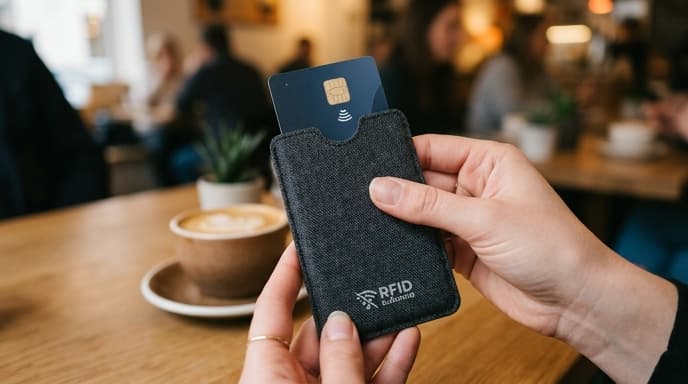
Understanding how electromagnetic shielding works helps you select sleeves made from composite materials that reliably block wireless interrogation.
The Operational Frequency: Why 13.56 MHz Matters
Payment cards follow the ISO/IEC 14443 standard and operate specifically at 13.56 megahertz (MHz). By comparison, building keycards and toll tags generally use either 125 kHz or ultra-high-frequency (UHF 860–960 MHz) bands.
The Frequency Mismatch Trap
Some card sleeves are tested and rated only against UHF frequencies. A sleeve that stops a UHF toll pass might let a 13.56 MHz payment signal through without resistance. Verify that any sleeve you buy lists attenuation specifically at 13.56 MHz.
Shielding Materials: Aluminum Foil vs Faraday Fabrics
To block radio signals, a sleeve has to act as a miniature Faraday cage by absorbing and redirecting the incoming field.
- Laminated Aluminum/Tyvek Composites: These sleeves layer aluminum foil between durable Tyvek sheets. They block the 13.56 MHz band effectively while remaining slim enough to slide into existing wallet slots.
- Woven Metallic Mesh / Faraday Fabrics: Fabric wallets use copper, nickel, or silver threads woven into a synthetic base. They flex easily and last a long time, provided the weave is dense enough to stop magnetic fields from leaking through.
- Rigid Metallic Alloy Cases: Aluminum or titanium cases block radio signals completely through solid metal walls. Just make sure the closure fits tightly; a gap of even two millimeters can let an external reader couple with the card's antenna at close range.
Decibel Attenuation Ratings (dB) Explained
Shielding performance is measured in decibels (dB) of signal reduction. Because decibels use a logarithmic scale, small numerical jumps represent large differences in protection:
- 20 dB Attenuation: Cuts 99% of signal strength, but a sensitive reader held against the wallet may still power the chip.
- 30 to 40 dB Attenuation: Cuts 99.9% to 99.99% of signal power. This is the ideal range for card sleeves, preventing the internal antenna from drawing enough current to respond.
- 50+ dB Attenuation: Heavy-duty shielding used mostly for forensics bags and radio isolation hardware, well beyond what a credit card requires.
Frequently Asked Questions
Can a skimming device steal my full credit card number and CVV code through my pocket?
Contactless EMV cards do not transmit your 3-digit CVV code or static card security values over the air; they produce a single-use cryptogram. However, unshielded cards can still transmit your card number and expiration date to nearby readers.
How do I test whether my RFID sleeve is actually working?
Install an NFC reader app on your smartphone. Tap your bare card against the phone until it chimes, then slide the card into the sleeve and tap it against the same spot to verify the phone no longer detects it.
Do RFID sleeves degrade or wear out over time?
Thin foil-laminate sleeves can develop small cracks along the folds after months of sliding in and out of leather pockets. Replace them if the paper starts tearing or the foil begins to separate at the edges.
Key Takeaways
- Contactless payment cards operate strictly at the 13.56 MHz high-frequency band under ISO/IEC 14443.
- Ensure shielding specifications explicitly confirm attenuation tested at 13.56 MHz, not just UHF bands.
- Target a minimum electromagnetic attenuation rating of 30 dB to 40 dB to prevent card activation.
- Tyvek-aluminum composite sleeves offer the best balance of thinness and radio-frequency shielding.
- Periodically inspect flexible sleeves for edge creasing and internal foil fractures.
Related Reading
- NFC Dynamic Cryptograms: Why In-Store Mobile Payments Beat Physical Cards
- Biometric Payment Cards: How On-Card Fingerprint Sensors Work
- Understanding Payment Card EMV Chips: Offline Counters vs. Online Authorizations