
Contactless credit and debit cards use Near Field Communication (NFC) for tap-to-pay transactions. While dynamic cryptograms prevent modern payment chips from being cloned, an exposed card can still transmit its cardholder name, account number, and expiration date to nearby readers. RFID-blocking sleeves act as small Faraday cages, blocking radio signals until you remove the card.
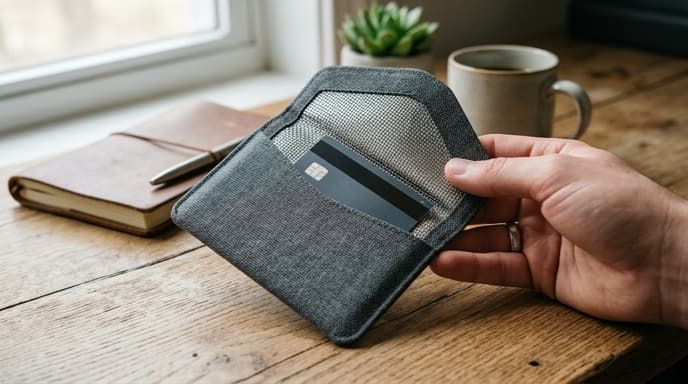
Choosing effective shielding requires checking frequency ratings, decibel attenuation, and material construction.
Operating Frequencies: 13.56 MHz Payment Cards vs. 125 kHz Building Badges
Radio-frequency identification uses several distinct spectrum bands. A shield built for one band will not work on another:
- 13.56 MHz (High Frequency / NFC): Contactless credit cards, debit cards, mobile payment chips, and electronic passports use the ISO/IEC 14443 standard at 13.56 MHz. Shielding must target this frequency to stop wireless readers from powering the card's passive chip.
- 125 kHz to 134 kHz (Low Frequency): Older parking fobs, building badges, and gate cards run on lower frequencies. Inexpensive metallic foils designed for 13.56 MHz payment cards rarely block 125 kHz signals.
- UHF (860–960 MHz): Used mainly for toll passes and warehouse inventory tracking. Match your shielding product directly to the frequency of the card you want to protect.
Shielding Effectiveness: Material Composition and Decibel Attenuation
The shielding performance of an RFID sleeve is measured by electromagnetic attenuation in decibels (dB). This rating shows how much the material reduces signal strength.
A shield with 30 dB of attenuation reduces signal transmission by 99.9%, while 60 dB reduces it by 99.9999%. For payment cards, look for tested attenuation of at least 40 dB to 50 dB at the 13.56 MHz frequency.
Material durability determines how long that protection lasts in your pocket. Inexpensive foil-lined paper sleeves tear easily and develop cracks along folds that leak radio waves. More durable sleeves use multi-layer composite textiles that sandwich woven copper, nickel, or silver thread between polymer or ripstop nylon layers.
Sleeves vs. Rigid Faraday Cases: Evaluating Form Factors
The best physical design depends on how you carry and use your cards:
- Individual thin sleeves: These slim laminate envelopes slip straight into standard wallet slots. They let you shield sensitive debit and credit cards while keeping transit passes or building fobs unshielded for quick tapping.
- Integrated RFID-blocking wallets: Shielding fabric is built directly into the wallet's outer shell. This protects everything inside, but opening the wallet uncovers all cards at once in public spaces.
- Rigid Faraday hardcases: Aluminum or carbon-composite shells protect cards from physical crushing while blocking radio signals. Make sure the interior uses non-conductive dividers so cards do not scratch against the metal.
Frequently Asked Questions
Can a thief clone my credit card by bumping against me with a smartphone?
Modern contactless cards do not transmit the 3-digit CVV code or the static data required to clone a magnetic stripe or chip. However, an unauthorized reader can still capture your 16-digit card number and expiration date, which some merchant websites accept without verification.
How do I test whether my RFID sleeve is working?
Put your card inside the sleeve and tap it against a retail payment terminal or an NFC-enabled smartphone running an open-source card-reading utility. If the terminal fails to detect the card, the sleeve is properly blocking the signal.
Do RFID sleeves interfere with magnetic stripes or chip contacts?
No. Shielding materials block electromagnetic radio waves. They have no static magnetic charge and will not damage magnetic stripes or EMV contact points.
Key Takeaways
- Payment cards run at 13.56 MHz; verify your shielding product specifically covers this frequency.
- Look for an attenuation rating of at least 40 dB to 50 dB to block reader signals reliably.
- Avoid plain paper-foil sleeves that crack at the folds; choose woven copper or nickel composite fabrics instead.
- Individual sleeves let you shield sensitive financial cards while keeping everyday transit cards accessible.
- Test your sleeve at a payment terminal to confirm it prevents NFC handshakes.
Related Reading
- Hardware Security Keys: Comparing FIDO2, NFC, and USB-C Specs for Banking
- Biometric Payment Cards: How On-Card Fingerprint Sensors Work
- NFC Dynamic Cryptograms: Why In-Store Mobile Payments Beat Physical Cards