
When a monthly electricity statement spikes, identifying which appliances caused the jump is difficult without direct measurement. Using smart plugs for energy monitoring turns theoretical utility budgeting into an empirical hardware audit, measuring the real-time cost of individual home devices.
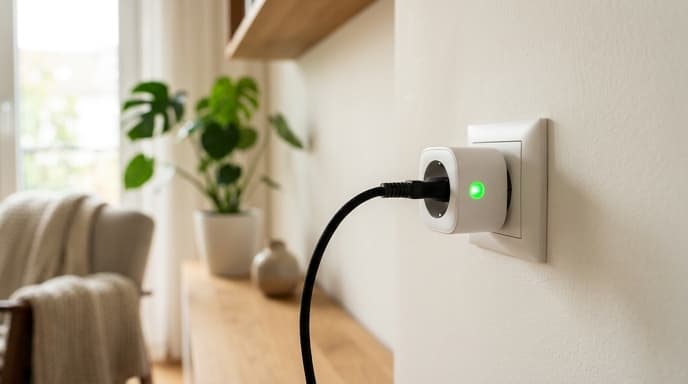
Not all smart plugs capture power data, and those that do have different electrical safety tolerances, sampling intervals, and data logging capabilities. Matching device specifications to your audit strategy ensures safe operation and dependable consumption logs.
Current Shunt Resistors and Voltage Sampling Accuracy
Basic remote-control smart plugs contain only a radio module and a mechanical relay to connect or disconnect power. Energy-monitoring plugs add an internal current shunt resistor and an analog-to-digital metering chip.
When electricity passes through the plug, the metering chip measures the voltage drop across the shunt resistor along with line voltage. Quality monitoring plugs measure true root-mean-square (RMS) voltage, active power (watts), apparent power (VA), and cumulative consumption (kilowatt-hours). Look for plugs with an error tolerance under 1% to 2% to ensure measurements align with your utility meter.
Continuous Load Amperage and Safety Ratings
Auditing large appliances like dehumidifiers, space heaters, or window air conditioners requires checking the plug's relay rating. A plug labeled for standard household wall outlets must handle continuous heat dissipation safely.
- Amperage ceiling: Standard household circuits run at 15 amps. Verify that your energy-monitoring plug is explicitly rated for a 15A continuous resistive load, rather than a cheaper 10A light-duty rating.
- Safety certifications: Look for recognized testing marks, such as UL (Underwriters Laboratories) or ETL. Uncertified plugs operating near continuous maximum draw present serious thermal fire hazards.
- Overload shutoff: Higher-end monitoring plugs include hardware-enforced over-current and thermal cutoff circuits that cut relay power instantly if an appliance draws excessive current.
Cloud Dependency vs Local Data Logging
How the plug exports power readings determines the privacy and usefulness of your energy audit:
- Proprietary cloud apps: Many consumer plugs send telemetry directly to vendor cloud servers. While easy to view on a phone, they often limit you to pre-aggregated daily averages and prevent raw CSV exports for modeling usage against tiered rates.
- Local telemetry and open standards: Plugs that support local network communication (such as Matter or open local APIs) allow you to collect second-by-second wattage logs directly on your computer or home server. This granular data helps you calculate the exact cost of vampire draw when devices sit idle.
Frequently Asked Questions
What is vampire draw, and can an energy-monitoring plug detect it?
Vampire draw (or phantom load) is the power drawn by appliances while in standby or "off" mode. Accurate monitoring plugs can detect loads down to 0.1 watts, letting you identify chargers, consoles, or entertainment gear that draw power continuously.
Can I leave an energy-monitoring smart plug connected permanently?
Yes. The monitoring plug itself consumes minimal electricity (typically under 1 to 2 watts) to power its internal radio and logic circuits, making it practical for year-round tracking.
Can these plugs help me calculate time-of-use utility billing costs?
Yes. By logging timestamped consumption data, you can cross-reference when heavy appliances run against your electric utility's peak and off-peak rate schedules to adjust when you use them.
Key Takeaways
- Energy-monitoring smart plugs measure true active power consumption at the wall outlet.
- Verify a 15-amp continuous load rating and independent safety certification before testing heavy heating or cooling equipment.
- Internal shunt chips should feature low measurement error margins for accurate kilowatt-hour calculations.
- Local telemetry protocols provide raw time-series data without vendor cloud lock-in.
- Isolating sub-watt phantom standby loads reveals opportunities to cut recurring utility costs.
Related Reading
- How to Audit Utility Statement Line Items Using a Text Parser
- Smart Plugs with Power Monitoring for Home Energy Budget Auditing
- How to Run a Mid-Month Cash Flow Triage When Spending Runs Hot