
You finished a tough workout yesterday, but you feel great today. Should you push for a new personal record, or take it easy? Instead of relying on subjective feelings, you can use an objective metric to guide your decision: Heart Rate Variability (HRV).
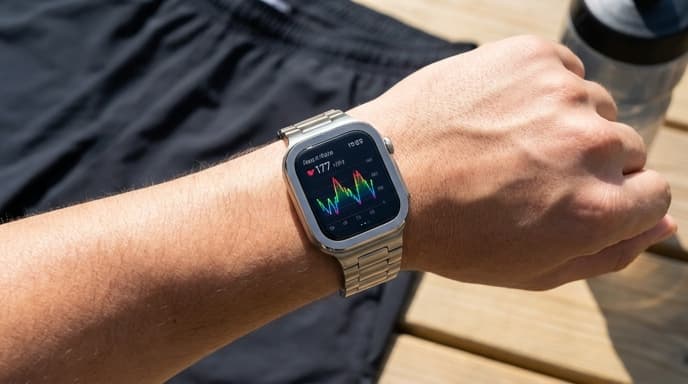
HRV is a powerful tool for measuring your body's recovery status. It gives you a daily snapshot of how well your nervous system is handling the cumulative stress of training, work, and life. Learning to interpret this data can help you train smarter, recover faster, and break through plateaus without burning out.
What Is Heart Rate Variability?
Your heart doesn't beat with perfect regularity. Heart Rate Variability is the measure of the variation in time between each consecutive heartbeat. These variations are controlled by your autonomic nervous system (ANS), which has two branches:
- Sympathetic (Fight-or-Flight): This branch prepares you for action and stress. It increases your heart rate and makes it more regular, leading to a lower HRV.
- Parasympathetic (Rest-and-Digest): This branch controls recovery and relaxation. It allows your heart rate to vary more between beats, leading to a higher HRV.
A higher HRV generally indicates that your body is well-rested and your parasympathetic system is active. You're recovered and ready to handle stress, including intense training. A lower HRV suggests your sympathetic system is dominant, meaning your body is under stress and may need more recovery before another hard workout.
How to Measure Your HRV Reliably
To get useful data, consistency is key. Most modern wearables—like smart rings and fitness watches—can track HRV automatically, typically while you sleep. For the most accurate reading, follow a consistent protocol.
- Measure at the same time every day. The best time is immediately upon waking, while you're still lying down and before you've had coffee or looked at your phone.
- Use a reliable device. A chest strap heart rate monitor is often considered the gold standard, but many modern wearables provide good directional data.
- Be still and calm. Take the reading in the same position (e.g., lying on your back) for 1-5 minutes, breathing normally.
- Log your data. Use an app that tracks your HRV over time and establishes a personal baseline.
Interpreting Your Daily HRV Score
Your absolute HRV score isn't as important as how it compares to your own personal baseline. A 'good' HRV for you might be different from someone else's. The key is to look at the daily trend relative to your normal range, which usually takes a few weeks to establish.
The Traffic Light System: A Simple Guide
Many athletes use a simple traffic light system to make daily training decisions:
- Green (HRV is within or above your normal range): Your body is recovered and ready for a high-intensity workout. This is a good day to push hard, attempt a PR, or tackle your most demanding session of the week.
- Amber (HRV is slightly below your normal range): Your body is showing signs of fatigue. Consider reducing the intensity or volume of your planned workout. You could opt for an active recovery session, focus on technique, or do a moderate-intensity workout instead of a high-intensity one.
- Red (HRV is significantly below your normal range): This is a clear signal that your body is under significant stress. High-intensity training today would likely do more harm than good. Prioritize recovery: take a full rest day, do some light stretching or mobility work, or go for a gentle walk.
Look Beyond the Daily Score: Long-Term Trends
Don't overreact to a single low reading. A night of poor sleep, a stressful day at work, or a couple of alcoholic drinks can temporarily suppress your HRV. The real power comes from observing the trend over weeks and months.
If your HRV baseline is trending upwards over time, it's a great sign that your fitness is improving and your body is adapting well to your training load. If it's consistently trending downwards, it could be an early warning sign of overtraining, chronic stress, or impending illness, giving you a chance to adjust before you're forced to stop.
FAQ: Using HRV for Training
Is a higher HRV always better?
Generally, a higher HRV relative to your baseline is a sign of good recovery and fitness. However, an unusually high HRV can sometimes indicate an overactive parasympathetic system trying to recover from extreme fatigue. Context is everything; look at the trend, not just one number.
How long does it take for HRV to recover after a hard workout?
This varies widely based on the workout's intensity and your personal fitness level. It can take anywhere from 24 to 72 hours. Tracking your HRV daily will show you exactly how your body responds to different types of training stress.
Can factors other than training affect my HRV?
Absolutely. Your HRV is a measure of total systemic stress. Poor sleep, mental stress, nutrition, hydration, and alcohol consumption all have a significant impact on your daily score.
Key Takeaways
- HRV measures the variation between heartbeats, reflecting the balance of your autonomic nervous system.
- A higher HRV relative to your baseline generally indicates good recovery and readiness to train.
- A lower HRV suggests your body is under stress and may need more recovery.
- Measure your HRV consistently every morning to establish a reliable baseline.
- Use a simple 'traffic light' system (green, amber, red) to adjust your daily training intensity based on your HRV score.
- Pay attention to long-term trends to monitor your adaptation to training and avoid overtraining.
Related Reading
- How to Structure a Deload Week for Maximum Recovery
- Zone 2 Cardio Training: The Foundation for Endurance
- How to Use Advanced Sleep Metrics to Structure Your Training