
The kettlebell swing is a foundational exercise for building power, strength, and endurance. When done correctly, it's a devastatingly effective movement that trains your entire posterior chain—the glutes, hamstrings, and back. When done incorrectly, it's an inefficient and risky shoulder exercise.
The secret is understanding that the swing is not a squat and it's not an arm lift. It is a powerful hip hinge. Your arms are just ropes; your hips are the engine. This guide will break down the technique step-by-step so you can master the movement safely and effectively.
The Setup: Your Foundation for Power
Everything starts before you even move the kettlebell. A proper setup puts you in the strongest possible position to generate force.
- Stance: Place the kettlebell on the floor about a foot in front of you. Stand with your feet slightly wider than shoulder-width apart, with your toes pointed slightly outwards.
- The Hinge: Push your hips straight back as if you're trying to touch a wall behind you with your butt. Keep your back flat and your chest up. Allow your knees to bend slightly, but don't squat down. You should feel a stretch in your hamstrings.
- The Grip: Reach forward with both hands and grab the kettlebell handle. Your grip should be firm but not a death grip. Tilt the handle towards you. Your arms should be straight and your shoulders packed down and back.
The Movement: A Four-Part Breakdown
Think of the swing as a continuous, fluid motion. We'll break it down into parts to learn it, but the goal is to blend them together seamlessly.
Step 1: The Hike Pass
This is the start of the swing. From your setup position, 'hike' the kettlebell back between your legs, like a center in American football. Aim high up into the groin area. Your forearms should make contact with your upper thighs. This loads the hamstrings and glutes for the explosive part of the movement.
Step 2: The Explosive Hip Drive
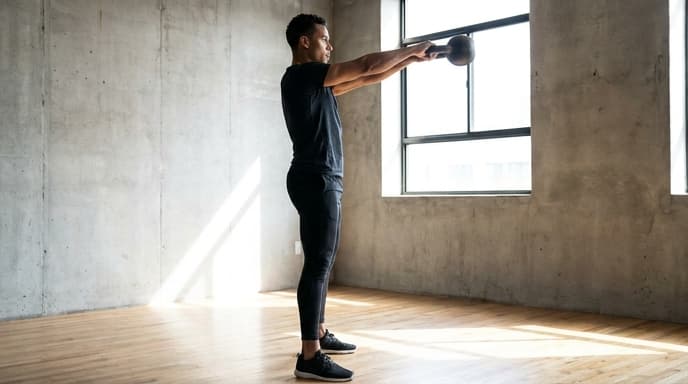
This is the most critical part of the swing. As soon as the kettlebell reaches its backmost point, drive your hips forward with maximum force. Squeeze your glutes and hamstrings as hard as you can. The motion is a violent 'snap' of the hips, propelling you from a hinged position to a tall, standing plank. This hip explosion is what moves the kettlebell—not your arms.
Step 3: The Float
The power from your hip drive will project the kettlebell upwards and forwards. Let it float up. Your arms are just guiding it. The bell should travel to about chest height. You should be standing perfectly straight, in a solid plank position (abs tight, glutes squeezed). Do not lean back or use your shoulders to lift the bell higher.
Step 4: The Return
As gravity brings the kettlebell back down, let it swing back between your legs. Don't fight it, but guide it. Hinge at your hips at the last possible moment, letting the bell's momentum load you up for the next repetition. Absorb the force with your hamstrings and glutes and immediately transition into the next hike pass.
Common Mistakes to Avoid
- Squatting the Swing: This is the most common error. If your knees are bending significantly and your torso is staying upright, you are squatting. The swing is a horizontal projection of power from the hips, not a vertical lift from the legs. The fix: Practice the hip hinge without a weight first.
- Lifting with the Arms and Shoulders: If your arms are sore after swings, you're doing it wrong. The arms are merely hooks connecting your body to the weight. The fix: Keep your arms relaxed. Think of them as ropes. The power comes 100% from the hips.
- Rounding the Lower Back: Your spine should remain neutral (flat) throughout the entire movement. Rounding your back under load is a major injury risk. The fix: Keep your chest up and engage your lats to keep your shoulders pulled back.
FAQ: Mastering the Kettlebell Swing
How high should the kettlebell go?
For a standard Russian kettlebell swing, the bell should float up to about chest height. There is a variation called the American swing where it goes overhead, but this requires much more shoulder mobility and is not recommended for beginners.
What's the right way to breathe?
Breathing is crucial for generating power and maintaining core stability. Take a sharp sniff of air through your nose as the bell goes back. Then, exhale forcefully through your mouth (a 'tsss' sound) as you snap your hips forward. This is called biomechanical breathing match.
What weight should I start with?
Start lighter than you think. Technique is far more important than weight. A common starting weight for men is 16 kg (35 lbs) and for women is 8-12 kg (18-26 lbs). Master the form before you increase the load.
Key Takeaways
- The kettlebell swing is a hip-hinge movement, not a squat. Power is generated by snapping the hips forward.
- Your arms act as guides; they do not lift the weight. The posterior chain (glutes and hamstrings) does all the work.
- Maintain a flat, neutral spine throughout the entire exercise to prevent injury.
- The setup is critical: get into a proper hinge position before you ever 'hike' the bell.
- Match your breathing to the movement: inhale on the way back, exhale forcefully on the hip snap.
Related Reading
- How to Structure a Deload Week for Maximum Recovery
- Proprioception Drills to Improve Balance and Coordination
- Zone 2 Cardio Training: The Foundation for Endurance