
Many of the most powerful movements in strength training, from the deadlift to the kettlebell swing, rely on one fundamental pattern: the hip hinge. It's the body's primary way of bending and lifting, using the powerful muscles of your posterior chain—your glutes and hamstrings—instead of your vulnerable lower back.
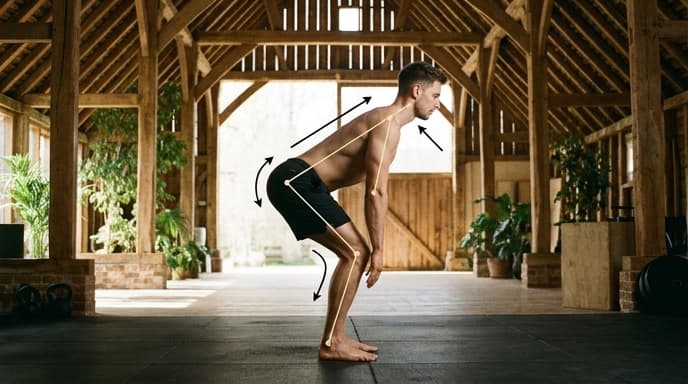
Failing to distinguish between a hip hinge and a squat (bending at the knees) is one of the most common causes of lifting-related injuries. Learning to hinge correctly is non-negotiable for anyone serious about building strength safely and effectively. This guide will teach you how.
Hip Hinge vs. Squat: What's the Difference?
Before you can learn the hinge, you must understand how it differs from a squat. Both involve bending, but the primary driver is different.
- In a Squat: The primary movement is vertical. Your torso stays relatively upright as you bend your knees and drop your hips down. Think of sitting in a chair.
- In a Hip Hinge: The primary movement is horizontal. Your hips travel backward as if you're trying to push a door closed behind you. Your shins stay relatively vertical, and there's only a slight bend in your knees.
Learning this distinction is the first step to protecting your spine. A deadlift is a hinge, not a squat with a barbell in your hands.
Drills to Master the Hip Hinge Pattern
The hip hinge can feel unnatural at first. These drills provide feedback to help you learn the correct motor pattern without any weight.
Drill 1: The Wall Tap
This drill teaches you the 'hips back' cue.
1. Stand about six inches in front of a wall, facing away from it.
2. Place your feet shoulder-width apart with a soft bend in your knees.
3. Keeping your chest up and back flat, push your hips straight back until your glutes tap the wall.
4. Squeeze your glutes to drive your hips forward and return to a standing position.
If you have to bend your knees excessively to reach the wall, you're too far away. If you reach it without feeling a stretch in your hamstrings, you're too close.
Drill 2: The Dowel Rod Guide
This drill teaches you to maintain a neutral spine.
1. Hold a dowel rod, broomstick, or PVC pipe vertically along your back.
2. It should make contact with your body at three points: the back of your head, between your shoulder blades, and your tailbone.
3. Perform the hip hinge movement, pushing your hips back.
4. If the dowel loses contact with any of these three points, it means you've rounded your back. The goal is to keep all three points of contact throughout the entire movement.
Putting It All Together
Once you can perform these drills correctly, you have learned the basic hip hinge pattern. You'll feel a distinct stretch in your hamstrings at the bottom of the movement and a powerful contraction in your glutes as you return to standing. This is the foundation you'll use for more advanced exercises. Practice it consistently until it becomes second nature.
Frequently Asked Questions
My lower back feels tight when I do this. Am I doing it wrong?
Possibly. It could mean you're still initiating the movement by arching your lower back instead of pushing your hips back. Return to the dowel rod drill to focus on maintaining a neutral spine. It could also be due to very tight hamstrings, which will improve over time.
How low should I go in a hip hinge?
You should only go as low as you can while maintaining a flat back. For many people, this is when their torso is roughly parallel to the floor. Flexibility will determine your end range of motion.
Is this the same as a Romanian Deadlift (RDL)?
Yes, a bodyweight hip hinge is essentially the same movement pattern as a Romanian Deadlift. Once you master the pattern, you can add weight (like dumbbells or a barbell) to perform an RDL, which is an excellent exercise for strengthening the entire posterior chain.
Key Takeaways
- The hip hinge is a fundamental movement where the hips travel backward and forward.
- It is distinct from a squat, where the hips travel primarily up and down.
- Mastering the hinge uses the powerful glutes and hamstrings to lift, protecting the lower back.
- Use drills like the wall tap and dowel rod guide to learn the correct motor pattern.
- A proper hinge involves a neutral spine, vertical shins, and a stretch in the hamstrings.
Related Reading
- Master the Kettlebell Swing: A Step-by-Step Technique Guide
- How to Do Your First Pull-Up: A 5-Step Progression Plan
- A Beginner's Guide to Dynamic Warm-Ups for Any Workout