
Computers don't understand words. They understand numbers. So how can a machine possibly grasp the subtle difference between 'happy' and 'ecstatic' or know that 'king' minus 'man' plus 'woman' results in something very close to 'queen'? The answer lies in a foundational concept of modern AI: text embeddings.
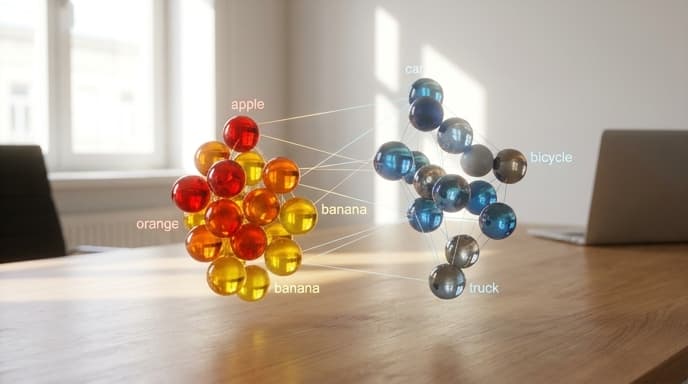
At its core, an embedding is a way to translate a piece of text—be it a single word, a sentence, or an entire document—into a list of numbers. This list of numbers is called a vector. This isn't just a random translation; the vector is designed to capture the semantic meaning, context, and relationships of the original text.
An Analogy: A Library for Ideas
Imagine a massive library where every book has a unique location code. A simple library might organize books alphabetically. A more advanced one might use the Dewey Decimal System to group books by subject. An embedding model does something far more sophisticated. It's like a magical librarian that reads every book and assigns it a coordinate in a vast, multi-dimensional space.
In this 'idea space,' books with similar themes are placed close together. A book about Roman history would be near a book about Greek history, but very far from a book on quantum physics. The vector is the 'coordinate' of that book in the idea space. By comparing the coordinates, you can find related books without ever having to read them.
What Do the Numbers Mean?
An embedding vector might look like this: [0.02, -0.45, 0.89, ..., -0.12]. It can have hundreds or even thousands of dimensions (numbers in the list). Each dimension represents a different abstract attribute of the text's meaning, learned by the model from analyzing massive amounts of text. One dimension might represent formality, another might relate to living vs. non-living things, and others might be too abstract for humans to label.
The exact value in each dimension isn't what's important. What matters is the relationship between the vectors. By using a mathematical calculation called cosine similarity, an AI can measure the 'distance' between two vectors. A small distance means the original pieces of text are semantically very similar.
How Are Embeddings Used?
Embeddings are not just a theoretical concept; they are the engine behind many of the AI features you use every day.
Semantic Search
Traditional keyword search finds documents that contain your exact search term. If you search for 'how to make a car go faster,' it will miss an article titled 'Tips for Improving Vehicle Performance.' Semantic search is different. It first creates an embedding of your query. Then, it compares that embedding to a pre-computed database of embeddings for all your documents. It returns the documents whose vectors are closest to your query's vector, even if they don't share any keywords. This is how it finds results based on meaning and intent, not just words.
Retrieval-Augmented Generation (RAG)
RAG is the technology that allows LLMs to answer questions about your private documents. When you upload a PDF to a service like ChatGPT, it's first broken into chunks, and an embedding is created for each chunk. When you ask a question, the system creates an embedding of your question and uses semantic search to find the most relevant chunks from your document. These chunks are then fed to the LLM along with your question, giving it the context it needs to provide an accurate answer.
Recommendations
When a streaming service recommends a new show based on what you've watched, it's often using embeddings. It creates a vector representation of your viewing history and then finds movies or shows whose vectors are located nearby in the 'entertainment taste space'.
For Developers: Models and Databases
Creating and using embeddings involves two main components:
- Embedding Models: These are specialized machine learning models trained specifically to convert text into vectors. You provide text to their API, and they return the embedding. Examples include models from OpenAI, Cohere, or open-source options like those on Hugging Face.
- Vector Databases: Storing and searching through millions of vectors efficiently requires a specialized database. Vector databases (like Pinecone, Weaviate, or Chroma) are designed to perform lightning-fast similarity searches on massive datasets of embeddings.
FAQ
Are embeddings only for text?
No. The same concept can be applied to other data types. There are image embeddings that capture the visual content of a picture, audio embeddings for sound, and even multi-modal embeddings that represent a combination of text and images.
Do different models create the same embeddings?
No. Every embedding model has its own unique 'idea space.' A vector created by one model is meaningless to another. You must use the same model to create the embeddings for your documents and for your search queries.
How are embedding models trained?
They are typically trained on vast datasets of text from the internet. The model learns by predicting words in context. Through this process, it learns which words tend to appear in similar contexts, and it adjusts its vectors so that those words end up close to each other in the vector space.
Key Takeaways
- Embeddings turn meaning into math. They are numerical representations (vectors) of text that capture semantic relationships.
- Closeness equals similarity. The distance between two vectors in the embedding space indicates how similar in meaning the original pieces of text are.
- They power modern search. Semantic search uses embeddings to find results based on intent, not just keywords.
- Embeddings are the foundation of RAG. They allow LLMs to find relevant information in custom knowledge bases.
- They are a fundamental AI building block. Understanding embeddings is essential to understanding how AI processes and 'understands' language.
Related Reading
- What Is RAG? The AI Workflow That Connects LLMs to Your Data
- Fine-Tuning vs. RAG: Which Is Right for Your AI Project?
- How to Use Multimodal AI in Your Creative Workflow