
In electronic trading, the path a network frame takes through a server determines whether an order fills at the target price. For decades, trading systems ran as standard software processes on top of conventional operating systems. As execution windows dropped into sub-microsecond territory, standard CPU architecture hit hardware constraints that software optimization could not resolve.
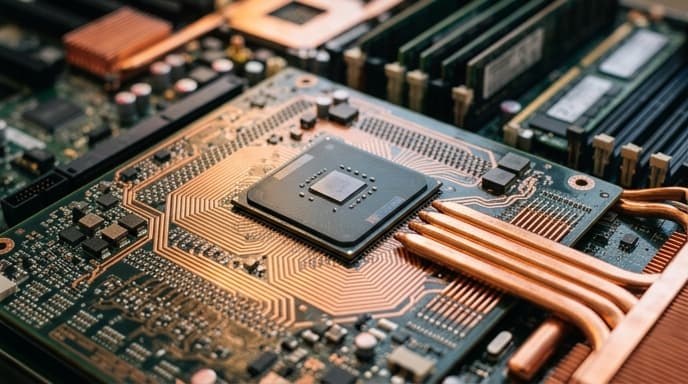
Assessing FPGA trading execution means looking at how dedicated silicon logic differs from general-purpose CPUs. By moving packet processing onto programmable gates, trading firms bypass the operating system entirely.
The Software Socket Bottleneck: Kernel Context Switches
In a standard operating system, an incoming Ethernet packet with market data must pass through multiple software layers. The network card receives an optical signal, fires an interrupt, copies the frame into system memory via Direct Memory Access, and notifies the OS kernel.
The kernel then performs a context switch to hand that data to user space. This sequence creates several distinct sources of delay:
- CPU Interrupt Overhead: Interrupting running threads to handle hardware events costs hundreds of CPU clock cycles.
- Cache Misses: Moving packet buffers across memory levels drops throughput whenever CPU cache lines invalidate.
- OS Scheduler Jitter: Thread contention on multicore processors causes unpredictable variations in processing time.
Kernel-bypass drivers cut out part of this path, but the trading logic still waits for the CPU to execute instructions in sequential order.
Hardware Acceleration: Gate Logic Without an Operating System
Field-Programmable Gate Arrays use an entirely different structure. An FPGA is an array of configurable logic blocks wired through programmable interconnects. Instead of executing compiled machine instructions sequentially, engineers write hardware description code in Verilog or VHDL to configure the physical silicon logic directly.
When an optical feed hits the FPGA's SFP cage, the chip parses the bitstream at the MAC layer as it arrives off the wire. The logic extracts market fields in parallel. If incoming quotes trigger a trade condition, the FPGA constructs the outbound order packet and transmits it back onto the fiber within hundreds of nanoseconds, without involving host RAM or the CPU.
Hardware-Enforced Pre-Trade Risk Checks
Fast order generation requires immediate safety checks. Financial regulations mandate strict pre-trade risk controls on automated execution channels. Because CPU-based validations introduce latency, firms implement risk limits directly in FPGA hardware pipelines.
These silicon circuits check order sizes, price bands, and credit thresholds alongside packet parsing. If an algorithm sends an order that breaches preset limits, the gate logic drops the frame within nanoseconds before it can reach the exchange matching engine.
Frequently Asked Questions
Can retail traders utilize FPGA execution cards at home?
PCIe FPGA boards are available off the shelf, but running them effectively requires direct exchange cross-connects inside colocation data centers and specialized HDL code. For home workstations, high-performance network cards and optimized software remain the practical choice.
How does an FPGA differ from an ASIC in market infrastructure?
An Application-Specific Integrated Circuit has its circuits permanently etched during fabrication. It cannot be altered, which makes it fast and power-efficient but expensive to design. An FPGA can be reprogrammed in minutes whenever exchange protocols or internal trading rules change.
Does FPGA routing guarantee that an order executes at the desired price?
No. While an FPGA cuts internal server latency, queue priority on the exchange order book and physical distance from the matching engine also determine whether an order fills.
Key Takeaways
- Standard software sockets incur latency penalties due to operating system interrupts and memory copying.
- FPGA hardware processes market data packets directly at the physical and data link layers in silicon logic.
- Reconfigurable logic blocks allow trading systems to execute complex logic in parallel without CPU clock cycles.
- Pre-trade risk controls can be embedded directly into hardware gates to enforce compliance without latency loss.
- Hardware acceleration forms the foundation of collocated matching engine interfaces in contemporary exchanges.
Related Reading
- Low-Latency Network Interfaces: How Solarflare and NIC Hardware Shape Market Execution
- Precision Time Protocol Hardware: How Exchange Clocks Enforce Market Integrity
- How Algorithmic Execution Orders Work in Modern Trading Terminals