
Maintaining strength while traveling can feel like a losing battle. Without access to weights, it's easy to fall into a routine of high-rep, low-intensity exercises that do more to maintain endurance than build muscle. The key to breaking this cycle is understanding how to progress bodyweight exercises using the same principles you would in a gym.
The secret is progressive overload. This simply means finding ways to make an exercise harder over time to force your muscles to adapt and grow stronger. With weights, you add another plate to the bar. With your body, you have to be more creative by manipulating leverage, stability, and time.
The Core Principles of Bodyweight Progression
Before we get into specific exercises, understand the toolkit you're working with. To make any bodyweight move more challenging, you can alter one of these variables. Master one before moving to the next.
- Change the Angle or Leverage: Shifting your body's position changes how much weight you're lifting. Elevating your feet during a pushup is a classic example.
- Increase Time Under Tension (TUT): Slow down the movement. Instead of a one-second descent in a squat, try a five-second descent. This forces your muscles to work harder through the entire range of motion.
- Reduce Stability: Performing an exercise on one leg instead of two, or bringing your hands closer together in a pushup, forces your stabilizing muscles to work overtime.
- Increase Range of Motion: Going deeper into a squat or a lunge makes the exercise more difficult and engages more muscle fibers.
How to Progress Upper Body Exercises: The Pushup
The standard pushup is a great starting point, but your body will adapt quickly. Here's a clear progression path from beginner to advanced.
- Incline Pushups: Start with your hands on a high surface, like the edge of a desk or bed. As you get stronger, use lower surfaces until you can do them on the floor.
- Standard Pushups: Master these with perfect form—a straight line from your head to your heels.
- Decline Pushups: Elevate your feet on a chair or suitcase. This shifts more of your body weight onto your chest, shoulders, and arms.
- Archer or Typewriter Pushups: From the bottom of a wide pushup, shift your weight from one side to the other. This introduces a unilateral element.
- One-Arm Pushups: The ultimate goal for many. Start with one-arm incline pushups and gradually work your way to the floor.
How to Progress Lower Body Exercises: The Squat
Bodyweight squats are fundamental, but you need to add resistance to keep building leg strength. Don't just do more reps; make each rep harder.
- Tempo Squats: Use the Time Under Tension principle. Squat down over 3-5 seconds, pause for a second at the bottom, and explode back up.
- Pause Squats: Hold the bottom position of the squat for 3-5 seconds before standing up. This builds strength in the most challenging part of the lift.
- Jumping Squats: Adding a plyometric element increases power and intensity. Focus on landing softly.
- Split Squats and Lunges: Shifting the work to one leg at a time is a form of reducing stability.
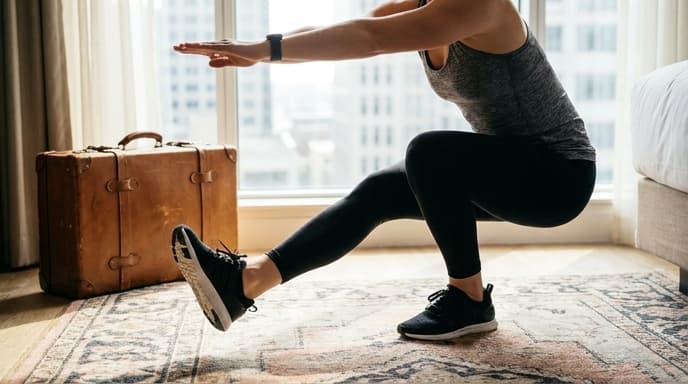
- Pistol Squats (One-Legged Squats): This is an advanced move that requires significant strength, stability, and mobility. Use a chair or door frame for support as you learn the movement.
FAQ: Bodyweight Progression
How many reps should I do before making an exercise harder?
A good rule of thumb is to progress once you can comfortably perform 3-4 sets of 12-15 reps with perfect form. If you can do 20+ reps easily, the exercise is likely too easy to build maximum strength.
Is it possible to build muscle with only bodyweight exercises?
Yes, especially for beginners and intermediates. By consistently applying progressive overload, you create the necessary stimulus for muscle growth. It requires more planning than lifting weights, but it is absolutely possible.
How often should I work out while traveling?
Aim for consistency over intensity. Three 20-30 minute sessions per week is a great target to maintain strength and routine. Listen to your body, especially when dealing with jet lag or a busy schedule.
Key Takeaways
- Progressive overload is the key to getting stronger, with or without weights.
- You can make bodyweight exercises harder by changing leverage, slowing down reps, reducing stability, or increasing range of motion.
- For pushups, progress from incline to decline, then to unilateral variations like archer pushups.
- For squats, use tempo and pauses before moving to single-leg variations like split squats and pistol squats.
- Focus on mastering the form of one variation before attempting a more difficult one.
Related Reading
- The 20-Minute Hotel Room Workout for Staying Strong on the Road
- The 3-Item Minimalist Gym You Can Pack in Any Suitcase
- A Practical Guide to Autoregulation in Your Training